Deep Impact

I remember seeing the Hollywood film
Deep Impact and thinking to myself how funny it was that Morgan Freeman got to play the President of the United States right when the world was ending. I joked about it with several friends, so I know it wasn't just me who'd noted the irony.
Deep Impact was dreadful, I think we can all agree, but was it prescient? Here's scholar Cornell West concerning Barack Obama: "The empire is in decline, the culture is in decay, the democracy is in trouble, financial markets near collapse. It's almost Biblical. And you can imagine what the black brothers and sisters in the barbershops and beauty salons say: 'Right when the thing is about to go under, they hand it over to the black man.'"
So what now, America? What happens now that Obama has been anointed Commander-in-Waiting? Fact is, his hands are tied in almost every imaginable way. Health care? Not with a 700 billion dollar giveaway on Wall Street. Bipartisanship? It's a nice word, but here's a better one—filibuster. Peace in Iraq? If you want to call a pullout from that shattered land peace, then maybe some facsimile of the concept will actually fill the vacuum, but even if Obama does remove the American boot from Iraqi necks, he has said he intends to place it upon Afghani necks, and meanwhile launch strikes inside the sovereign territory of nuclear-armed Pakistan. This is truly frightening, but let's face it—a country doesn't maintain more than 700 military bases around the world because it is devoted to the cause of peace.
I assumed the Democrats would lose yesterday and even made a twenty dollar bet to that effect about a year ago. The financial meltdown changed the landscape in ways I did not foresee back then, but still I was wrong, and I agree with Obama supporters: he was a better choice than McCain. McCain tried to talk a populist game, but he was just another taxcutter and deregulator. After sufficient time for the American sheeple to settle down and start munching the grass again, McCain would have channeled his inner Reagan, declared that government is the problem not the solution, and herded us all toward the abattoir. I am always amazed that a deregulatory rubric ever came to dominate America. I mean, here is a mega-society, interconnected and interdependent, in which the actions of a powerful few have far ranging and often unpredictable consequences, and yet the prevailing economic belief is, in effect, every man for himself.
This idea is the nth degree of derangement. How it passes for economics is a mystery to me. When I think of economists, the joke about three-hundred lawyers chained together at the bottom of the ocean comes immediately to mind. Economists believe there is a direct and empirical relationship between differential calculus models and the real world. They use advanced math, but they're just soothsayers playing in chicken guts. Periodically, the coven sends out a wizened spokesman who reiterates that, left to its own devices, markets will always correct themselves. This neo-liberal pseudo-science was pushed like a drug to the elitist ignoranti who pass as leaders and, before you knew it, the entire planet was caged by an economic doctrine even a high-schooler could tell you was destined to implode. Don't get me wrong. It's possible neo-liberal theories have
some merit—but only in a timeframe that is meaningless to living humans. Don't know about you, but I personally don't want to wait two-hundred years to see if unregulated employers will pay me a living wage.
Have you noticed that conservatives are constantly on the wrong side of history? Consider it. Conservatives didn't want to give up their slaves. They didn't want women to vote. They didn't want children to go to school rather than toil in deathtrap factories where they would lose their arms and eyes. They didn't believe there should be such a thing as the Fair Labor Standards Act, which brought about a minimum wage, eight hour work week, and time-and-a-half. They didn't want seat belts in cars, or insurance for workers. They didn't want limits on how much lead they could put in paint, or how much mercury they could dump in rivers, or how much CO2 they could spew into the air. They didn't want blacks to be able to vote, or go to college, or eat at the same lunch counters as whites. It goes on and on like a bad slasher flick. And this is a proud tradition?
My favorite example of ridiculous, dogmatic conservatism is this: conservatives didn't want returning WWII veterans to receive free college educations via Franklin Delano Roosevelt's G.I. Bill. This program helped create the American middle class, including a large proportion of the baby boomers who now call themselves Republicans. How's that for a slap in the face? Help some folks out and they become everything you oppose. It would be great if we could just take away rewards from people who don't deserve them, but that's core Republican thinking. Liberal programs, on the other hand, tend to spread beneficial effects to society
as a whole, which is good because (see paragraph three) we are interconnected and interdependent. Health care reform—good for society, admittedly bad for a minority of insurers and physicians. Sex education—proven to keep teen pregnancy and AIDS rates down (which in turn suppresses crime rates, homelessness rates, and imprisonment rates), admittedly infuriating for a minority of religious nuts. Social security—good for seniors, bad for people who would rather see the elderly starve or freeze to death on the streets.
In the next four years, I guess we'll just have to see whether Obama is a socialist, as his enemies say, or a typical center-right Democrat, as his record seems to indicate. But I think I know the answer already. I won't give it away. I'll just say that the rightwingers screaming that Obama is a socialist are frothing proof that my dad is right—as usual. He says, "Give some people

a plate of dog shit and authoritatively call it cream cheese, and they'll spread it on a bagel and eat it." The people calling Obama a socialist have brown stains on their napkins. What they're eating tastes uncannily like feces, but it
must be cream cheese because John McCain't said so.
But here's a question—what if Obama
were a socialist? In the
Guardian UK some Ohio hayseed who had clearly never seen even .01 percent of the world was quoted as saying the U.S. was now going the way of European socialist states—down the tubes. As a person living in a European socialist state, I'll consider Joe-the-Yokel's perspective as I go out this evening and watch the waves break upon the beach, and watch grandparents, parents, children, and lovers walking the promenade together, and listen to the abundant church bells ringing, and do all this in a spectacularly beautiful city without seeing a single cop, nor worrying that in their absence I'll be drawn and quartered by ravening criminals. And while I'm doing this, I will join the rest of the world in hoping—probably against hope—that November 4th, 2008 really does make a deep impact, and heralds a new beginning for us all.
Labels: barack obama, John McCain
Politics Can Be Beautiful

I stumbled upon a wonderful website called
Wordle that analyzes any text of your choice and rearranges it into visually pleasing graphic clouds. The java-based tool gives prominence to the most utilized words, and offers various menus for editing the final output. One of my favorite websites,
Guardian UK, used the application on John McCain's official blog and discovered that the most utilized word was "Obama." Then they used it on Obama's blog and found that the most utilized word was also "Obama." Draw whatever conclusions you wish.
I used Wordle on my last two political posts and discovered that their contents aren't so awful to consider after all. In fact, I get an almost peaceful feeling from contemplating these two lovely clouds. The cloud below looks like the work of a Bronx graffiti tagger whose favorite paint store ran out of primary colors. Using Wordle magic to transform politics into soothing pastel babel has proven to me that there's truly beauty in everything if you are desperate enough to look for it. Maybe Cindy McCain possesses a sort of mental Wordle that fires in the blink of a synapse whenever she gazes at her scabby old troglodyte of a husband.

There's another intriguing
website that functions very much like Wordle, using the speeches of American presidents to build what the site calls "tag clouds." By using a slider to go backward and forward in time, users see that the emphasis in speeches has changed over the last century. In just a few minutes of playing with this amazing little zeitgeist meter, I noticed that the word "constitution" was frequently utilized in presidential speeches for over a hundred years, sometimes even appearing as the
most utilized word. But in speeches from the last decade "constitution" has pulled a Houdini and all but disappeared. Gee, I wonder what that means?
Labels: barack obama, Guardian, John McCain, Wordle
Politics Redux

When I posted about Barack Obama a few weeks ago, friends seemed surprised that I wasn’t on the bandwagon. No disrespect to Barack, but my candidate was John Edwards. Why did I like Edwards? Well, he was vocally anti-corporate. Why is that important? Because excess corporate power is the problem from which all other problems flow. Iraq would never have been attacked if it hadn’t been a profitable scenario for corporations. Jobs wouldn’t be offshored if it weren’t profitable for corporations. The U.S. news media would broadcast actual objective news if it weren’t so profitable to instead to sell God, prejudice, and patriotism. Obama and Clinton are battling for the nomination of a supposedly progressive party, but neither of them seems interested in fighting corporate power. In fact they are each, in their own way, in the pockets of corporations. And corporations are at war against the American people. Don’t take it from me—let’s have a corporate shill tell you in his own words:
The threat to our culture comes from within. In the 1960s, there were welfare programs that created a culture of poverty in our country. Now, some people think we won that battle when we reformed welfare. But the liberals haven't given up. At every turn, they tried to substitute government largess for individual responsibility. They fight to strip work requirements from welfare, to put more people on Medicaid, and remove more and more people from having to pay any income tax whatsoever. Dependency is death to initiative, risk-taking and opportunity. Dependency is culture killing. It's a drug. We've got to fight it like the poison it is.This was Mitt Romney speaking on February 7th, as he shut down his campaign. I chose his statements because they outline conservative doctrine quite explicitly. You’ll get some version of what Romney said from pretty much any Republican you speak to. He suggests that largesse without responsibility is wrong, yet his party had no problem bailing out corrupt investment bankers to the tune of one trillion dollars. He thinks people who have minimal income should be obligated to pay income tax, while Republicans have reduced taxes on the rich over the past thirty years to an extent that has cost the United States trillions in operating capital. And he slams Medicaid, which is by far the most popular government program ever created. To make all this nonsense palatable to his hateful followers, he wraps everything in an attack on the poor, even making the insane claim that there was less poverty in the United States until welfare came along. It's all standard Republican speechmaking, a misdirection play designed to encourage people to punish those they hate, yet simultaneously gloss over the fact that the party's pro-corporate policies actually hurt all individuals.

Romney again:
If you depress the private sector you depress the well-being of all Americans. That's exactly what happens with high taxes, over-regulation, tort windfalls, mandates, and overfed, overspending government. Did you happen to see, by the way, that today government workers make more money than people who work in the private sector? Can you imagine what happens to an economy where the best opportunities are for bureaucrats? It is high time to lower taxes, including corporate taxes, to take a weed whacker... Get out—get out that weed whacker and take it to regulations and reform entitlements and, by the way, stand up to the increasingly voracious appetite of the unions in our government (at this point Romney gets a round of applause, and it’s the apocalyptic sound of hypnotized thousands cheering a multi-millionaire who is begging for financial help).
So here we have corporations, through one of their shills, openly declaring that they would like to pay fewer taxes. Romney can spout this effluvium without being stoned to death because few Americans, not even his starstruck supporters, understand that more than sixty percent of US-controlled companies pay no taxes. That's right—zero. More than seventy-percent of foreign-owned corporations operating in the U.S. pay no taxes either. But this isn’t good enough for big business. Somehow, they’re still unduly burdened. Let’s revisit Romney for a moment:
If you depress the private sector you depress the well-being of all Americans. I’ll just point out here that corporations that avoided taxes between 1996 and 2000 earned 3.5 trillion dollars in profit. It begs the question of how forgoing a nominal 35% taxation of 3.5 trillion dollars helps Americans. And along the same lines, why are there three trillion dollars available to fight a war, one trillion available to bail out Wall Street, but no money—according to George W. Bush—available for Social Security (which is a program an overwhelming majority of Americans support)?

Mitt Romney’s words are illustrative of corporate greed, but the fact that they are tolerated without cries for his public tarring and feathering are a symptom that Americans have surrendered. There was once a social pact that stated that if you took a job, worked it productively, and did not break the law, you would be rewarded with a stable existence and a peaceful retirement. You would be able to buy a house and raise a family. This promise was the impetus that drove the white middle class toward productivity (there were no promises made to blacks). Today, the entire middle class—white and black—are finding that they have been cast adrift. Everyone has heard about offshoring of manufacturing jobs. But how many people know that the Miami Herald newspaper recently outsourced a percentage of its copy-editing and design work to India? Sounds impossible, doesn’t it, but it’s true. Why pay expensive American professionals when Indian workers will do the same job for a fifth the wage? Just as a virus eventually destroys its host, so American corporations are in the processing of destroying America. No one listened when factory workers lost their jobs, but what about when professionals begin to feel their carefully built foundations crumbling? Are you an html architect? A graphic designer? That’s nice. I hope you’re also good at tending bar, because in another few years you’ll be mixing mai-tais eight p.m. to closing six days a week.
When a nation rescinds its most basic promises, can that nation thrive? The answer is no, and clearly, the United States ceased thriving a while ago. You hear quite a bit of propaganda extolling the rising GDP, but neither GDP nor the Stock Market possesses any real relationship to prosperity. It’s sort of like when you hear that a motion picture is number one at the box office. What has box office receipts to do with whether a movie is good? Nothing, of course. The same is true of GDP and the NYSE. Even as the corporate media conflate GDP with general prosperity, people’s pensions disappear, social security is attacked, and health insurance coverage vanishes for millions. The middle class and poor must constantly defend the few table scraps they possess from the rapacious rich, who already have enough resources to last ten lifetimes yet are still angry that a few gnawed chicken bones remain out of their reach. These sick monsters are like Daniel Day-Lewis in
There Will Be Blood: “I cannot abide another man’s success.” Well, no need to abide it, because it doesn’t exist anymore. The American working class was once the most prosperous on Earth, but in a mere thirty years it has been politically disempowered, divested of its wealth, and left behind. Corporations were able to effectively abolish workers’ rights by taking control of every federal agency in Washington, including the Department of Labor. They were able to disembowel the regulations that made the country’s managed capitalism successful for the working class. All of these policies were conceived and enacted by players on the right side of the political spectrum, and went unopposed by those on the left. Because of this collusion everyone is now suffering—both inner city blacks and suburban whites. Under the circumstances, you'd think it was time to stop fighting each other and start fighting the real enemy—people who refuse to believe in limits to what they should possess.
By any objective measure, the United States is a nation in steep decline. It’s been in decline since 1973, when the bottom 90% of wage earners reported an average income in adjusted dollars of $33,000 for the year. Since then that number has fallen sharply. Let's reiterate: Wages for 90% of the population have been falling since 1973. Yet approximately half of that 90% continue to support policies that hurt them. The United States now trails most of Western Europe in life expectancy, health care, child care, and has higher poverty rates and infant mortality. Those in the conservative orbit deny these facts. Rudolph Giuliani comes to mind—he claimed that England’s prostate cancer survival rate was half that of the United States, and much of the millionaire press corps, led by Fox News, defended this bald-faced lie. Those few on the right who admit that, okay yes, the numbers tell the true sad story that Americans live shorter, sicker, more stressful, poorer lives than most Western Europeans, lay the blame on blacks and illegal immigrants for dragging down the metrics of healthy and productive white folk. But Europe has massive immigration patterns as well. And those who immigrate to Europe do so from the most crushingly poor regions of the world, such as Pakistan and West Africa. Yet this influx of desperate millions has not decimated European health standards. U.S. health problems stem from deficiencies in care, not people. Each year, according to the Institute of Medicine, 100,000 people lose their lives in hospitals due to medical negligence. 18,000 more die each year because they cannot afford health care. Some studies place these figures much higher, so high in fact that in many circles medical negligence is considered to be the
number one cause of death among Americans.

In nearly every way imaginable Western Europe is a better place to live. Standard features of life include paid maternity leaves of up to six months and paid vacations of up to six weeks. European cities possess functional public infrastructures and full-service urban cores that reduce or eliminate the need to spend money on cars and gasoline, except by choice. Western Europe has low crime and incarceration rates, whereas in the U.S. one out of every one hundred adults is in jail or prison. Western Europe has miniscule rates of homelessness; in the U.S. half a million people or more live on the streets. There is more social mobility in France, Germany, and Scandinavia, than in the United States. The European Union attracts more foreign students than the U.S., and studies indicate this is not just because of the quality of education, but also because its consensus-driven polity is the societal model to which the developing world aspires. Western Europe is living proof that mixed-economy welfare states can be prosperous.
But in the United States the orthodoxy is that profits must always be at their greatest, whatever the cost to human beings. If a corporation makes a million dollars in a year but could make a million point two dollars by jettisoning on-site day care for its employees, it is obligated to do so, though this hurts the community. Not only is this an immoral philosophy, but the religion of growth-at-any-cost sells out humanity’s future. This is obvious to anyone who simply scans a WHO report. In order to feed the seven billion mouths that exist on this planet today, we need twice as much food and twice as much potable water as currently exists. By 2050, we will need three times as much. Water and food are not going to appear from outer space, so that means we’re already in serious trouble. The scarcity of resources forces nations to horde and fight for those that are available. Iraq needed to be destroyed not only to steal the oil for the United States, but also to keep it from China and India. More growth means more war. More war means more likelihood of nuclear war. It doesn't take a rocket scientist to figure this out.
Rather than continue to live the nightmare of war we can share resources, which would require collective sacrifice. This is the inevitable path for humanity if it is to save itself from destruction. Jeremiah Wright said 9/11 was “chickens coming home to roost” and was vilified for it. To deny that U.S. meddling in the Middle East set it on a course toward 9/11 is to deny that the Earth is round (or, better yet, to deny that killing nineteen of every twenty original inhabitants of North America was a genocide). Take careful note of those who are offended by Wright’s comments. The offended are people who have never read a history book, and would prefer that you didn’t either. I’ll accept people saying that Wright’s statements were difficult to hear because they were angry and accusatory. That I can buy—hey, even blackhearted conservative demagogues have feelings (though not for anyone else). But anyone who claims 9/11 occurred out of the blue, and had no relationship to U.S. policy in the Mid-East, is a liar or a mental case. Simply paying a fair price for oil from the very beginning would have been a good step toward preventing this tragedy, but the U.S. preferred to game the system. They preferred to replace Iran’s elected leadership with a dictator in 1953. It was kind of fun actually, like a spy novel. They fucked over naive Arabs while swilling martinis and noshing
canapés. But somehow the Arabs grew sophisticated enough to drive tanks and enrich uranium.
Hey! Hey now. Stop kidding around, Mahmoud. Play time is over buddy. You aren’t really mad at me are you? Mad at your Uncle Sam? After all I’ve done for you?
Believe it or not, it is possible to make an across-the-board social decision to
not maximize profit. Stateside, the mere suggestion of forgoing growth and profit would get you laughed out of any policy discussion, but in Europe they’ve not only suggested it—they’ve accomplished it. They have assembled a social safety net, which is by definition a drag on growth, but in return have less crime, less imprisonment, and a
greater social accountability than in the U.S., created by providing the working class a system they feel invested in preserving. Whereas in the U.S. one can only earn state assistance by humiliating oneself, in Europe assistance is considered a human right. Curbing desperation, resentment, and alienation in society is understood to be beneficial. It doesn't matter that you may not like the people you're helping—the positive effects are real, and outweigh your urge to be vindictive. It’s called socialism and it works. Europeans did not arrive at this choice by magic. Centuries of devastating warfare had a little something to do with their decision. They realized that warring for resources benefits only those who manufacture war machines. Sharing of resources does not prevent all upheaval, but if the alternative is to live like Americans, where the rich victimize the poor then retreat into gated communities patrolled by private shoot-to-kill police forces, then the Europeans have made their preferences clear.
There is quite a bit at stake in the upcoming election, and for the reasons explained above, I cannot support a pro-corporate candidate. Obama is an appealing character, but he isn’t campaigning to challenge the status quo. Quite the opposite—an Obama election would shore up American capitalism, make it easier to sell to suspicious third-world people who happen to be his approximate skin tone. And since securing a low-wage third-world work force even at the expense of U.S. prosperity is a major goal of business, Obama is a guy they wouldn’t mind having as the face of this initiative for four years. No matter which of the remaining major candidates is elected, the American decline gets steeper unless corporations are corralled and restrained. When will that happen? Well, let's just say that my pessimism on the subject is convincing enough to have spurred others to abandon the U.S. as I did in 2002. My friend Steve starts life in the Netherlands in July, and Charlie is now eyeing Spain. As for me, I become an expatriate again after Diana finishes her grad degree this summer. Perhaps leaving—and twice at that—is defeatist, but it keeps my tax money from greedy millionaires, which makes it a protest too. Leaving is also personally enriching, since life outside the States is quite beautiful for black Americans. That beautiful life is what this blog has mostly been about, and from now on I'll stick to that subject, and leave electoral politics behind (really this time).
Labels: barack obama, iran, mitt romney
Too Much Too Little Too Late

Fortunately Mr. Ehlers brought blacknotblack around to a little something I can handle. Images of white chairs and yours truly lend no thread for me to weave an interesting tale. Politics I can handle. And right now I have a better idea for the campaign song for presidency this year. Ladies and gentleman, Lady Deniece Williams, escorted by Sir Johnny Mathis:
linkAs an American who placed himself on the Nordic side of the planet, I constantly have to answer questions regarding life, liberty, and the pursuit of happiness, mainly because I moved from Los Angeles to Helsinki, not the other way around as historical trends portrayed. Go west young man? That was the trek of my grandfather.
I moved in with a woman, met my Finnish family I had not known, and looked forward to escaping imperialism. "Freedom!" I screamed from the roof tops and the bar stools, and few listened or understood. I left the hospitality industry for documentation and specification of graphical user interface design. I found more humanity in technical writing and composing copy than serving food, drink and fare to actual human beings. I also had to tell more people more often why I chose to leave the United States of America for Finland.
Gratuitous use of blog entry as supplant of confession so I can sleep in on Sundays . . . CHECK!

The concept of America never existed. I never saw it, never smelt it. The weaning was difficult, since I certainly remember where I'm from, and do not practice in the hype of assimilation nor anti-assimilation of expat pubs or sports bars. I stand out in the crowd, but that simply keeps me true to my personal history. I am a loner from Los Angeles living in Helsinki.
Now that Barack Obama has a damn good shot . . . fuck it, I guarantee he wins, helping the American bourgeousie cut the albatross from its neck, smiling at the collection of new things
white people like. Obama will win the election, most likely without any need of superdelegates, and must recognize his role as a janitor cleaning up the mess. The situation he shall inherit will provide enough smokescreen to obscure any special interest kickbacks he receives. Cue the Sergeant of Arms:
Madame speaker, here's the president, beeyatch! Stepping through a joint session of Congress for the State of the Union, with veep Hillary Clinton and House Speaker Nancy Pellosi sitting upright behind their leader. A black man up front and proud with two white women behind him for support. Only in America.
I notice he said yes, he would certainly pay Raúl Castro a visit without any preconditions. I do indeed dig the rhetoric Barack Obama speaks in terms of international relations. Obama seems to recognize how the U.S. of A is nothing more than one political entity in the world, one nation on a planet in need of liberty and justice for all.

Meanwhile the pursuit of happiness lives on in Finland. They respect civil liberties here, such as walking home from a bar at 3 in the morning. If the cops show up to break up a party, there's good reason for it. The marketing campaign in Finland officially states, “The Police Are Your Friends”. I only know they can wear beards, and only stopped me for questioning once, to make sure I was OK, and said have a good night when I told exactly how many pints I'd had. I feel fortunate to have dual citizenship, especially since the taxes I pay show a good return on investment.
Labels: barack obama, finland, johnny mathis
That Obama Glow
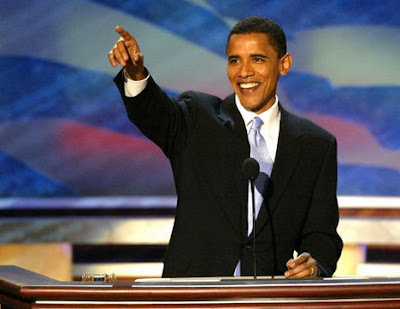
My goodness, Barack Obama’s golden glow is beginning to make him look like a life-sized Oscar. In my daily jogs around the trusty interweb, I continually encounter articles which label his speechmaking as “soaring rhetoric.” It is symptomatic of America’s sunken ideals that a presidential candidate is beatified for expressing himself about as well as the average sociology professor. On the other hand, perhaps it isn’t such a surprise people are impressed by his intelligence, considering the fact that the current president’s staffers spell out world leaders’ names phonetically in his speech notes. Imagine how hard Bush works to keep from giggling every time
POO-tin appears in front of him. If recent history is any guide, Obama’s eloquence may hurt him if he wins the Democratic nomination and finds himself pitted in debate against a quipping and unctuous John McCain. Swing voters, as we know, will look for any excuse to back a dumbass.
Barack Obama writes quite a bit about strategic thinking in his books. As I keep tabs on his campaign I can certainly see these ideas at work. Strategic thinking, as defined in the political realm, simply means working toward a single stated goal that will effect multiple changes which were
unstated. It’s a magic trick which Republican politicians perfected over the last thirty years, in large part because they realized Americans were too liberal across the spectrum to want most of the things their corporate bosses were demanding. For instance, the vast majority of Americans, whether New Yorkers or Alabamans, are too liberal to believe that leaving the elderly to fend for themselves is a good idea. Thus dismantling social security became “social security reform” in the Republican playbook. But in reality the reform was just another attempt at a destructive privatization designed to benefit a wealthy few.
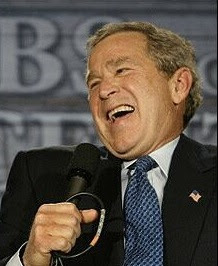
Many Americans hear the word privatization and immediately think it’s good. The reaction is a testament to the effectiveness of corporate brainwashing, particularly when you consider that one of the first resources to be privatized in the United States was its political system. Only recently are people finally starting to suspect that selling the government to the highest bidders is why the nation is at such a dangerous crossroads today. Of course, some of those across the aisle claim this is a crucial election for different reasons. And I suppose it is. For the millionaires, Bush’s tax cuts could become permanent and push the U.S. that much closer to a society in which they pay no taxes. For the fundamentalists, teaching children that the world is only several thousand years old could become a law, if not a constitutional amendment. For the chickenhawks, the U.S. could kill countless more human beings in another Middle Eastern nation, as behemoth war profiteers continue to
bleed the U.S. treasury, this time past the point of recovery.
Amidst all that is at stake, Obama claims to be the candidate of change. The real change he represents is that of a black president in the White House, something I'd love to see occur. But politically Obama is of the same stripe as other right-of-center Democrats. He supports border fencing and the death penalty, and also backed a law that makes it more difficult for consumers to sue corporations. This from a former civil rights attorney. He voted against an interest cap to rein in predatory credit card companies, and flatly stated that an impeachment of George W. Bush was not an option, a move that certainly doesn't signal a strong craving for change. It seems that when Obama says "change”, he’s simply trying to tap into voter discontent with being shut out of the government. This is a clever move. After decades of deregulation and unchecked corporate rule, most Americans are finally realizing that the price of all this has been utter marginalization. Yes, it appears that—and I’m stunned to say this,
stunned I tell you—that ceding governance to the moneyed elite has resulted in the elite taking even more money for themselves. Trickle down? Nigga please. The only thing that has trickled down is corporate poison into the community wellwater. How did these mega-millionaires manage such a flim-flam? They managed it by telling gullible Americans that it was Mexicans ruining things for them, or the French, or frivolous lawsuits, or black welfare recipients. The list is really endless, though strangely, never seems to include corporate crooks or billionaire tax cheats, who do more fiscal damage than all the former combined. Despite the omissions, it’s finally clear to all but the most rockheaded observers that the problem all along was the very people who were pointing fingers.
So into the breach comes Barack Obama, with his strategic thinking and his deliberately vague policy sketches. Hillary Clinton and others have suggested he is vague because he doesn’t know what he intends to do. They say he offers words to make people feel good, but no solutions when push comes to shove. Newsflash to Hillary—there
are no solutions. Obama said himself that anyone who thinks Congress is just going to pass a health care bill while insurance companies stand by and do nothing is dreaming. With this mostly unremarked-upon aside, he told Americans to forget about having an efficient, functional system like in the E.U. It ain’t gonna happen because the insurance companies and their mostly Republican shills aren’t going to allow it. But in a democracy, surely the will of the people will win out, won’t it? A few corporations can’t resist the will of tens of millions of people, can they? Ladies and gentlemen, please take note of exhibit A: more than 70% percent of Americans want stricter handgun control laws, but for the power of only one corporation—the NRA—these killing machines remain epidemic. Ergo, according to my personal law of extrapolation, tens of millions of people, however passionate, are helpless against the insurance cartel.


The main obstacle to change is that in order for these changes to occur, the wealthy have to be divested of a portion of their resources. I don’t mean they have to be guillotined like in the French Revolution. I just mean that within the American economic engine universal health care, for example, would require insurance companies to forgo some profits. As Obama noted, that’ll happen when strawberry Yoo-Hoo shoots out of all our nipples (though he didn't use that exact phrase). It's a sad reality, because, if memory serves, the type of restructuring I'm talking about actually did happen in American history—from the middle 30s through the late 1960s. What occasioned this downward shift of riches? Well, a grinding depression necessitated policies designed to alleviate mass suffering. Those policies—called the New Deal—shifted money to the poor by putting them to work, and created a social safety net. Pretty soon a war came along and gearing up for that effort created more jobs and dragged America the rest of the way out the economic morass. New Deal programs, maintained through the 50s and 60s, effectively created the American middle class. During the late 1960s the downward shift of resources continued via the civil rights movement.
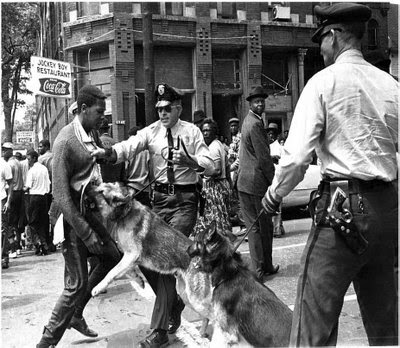
You may wonder, what were the greedy rich doing during this time? How were they neutralized? Well, there were quite a few angry citizens marching and rioting. During most of the 30s and again during most of the 60s, it looked as if a well-ordered society was disintegrating. The elite establishment realized chaos would eventually visit them even in their private country clubs. But they didn't give up right away—they're tougher than that. After thirty years of seeing American society become more equal at their expense they were ready to draw the line. So they shot some students, firehosed some civil rights marchers, and sent vicious attack dogs after unarmed protesters. But none of this silenced the cries for equality, and the elites saw clearly that nationwide chaos loomed. That would be bad for business, and this threat to their bottom line created a political opening that made change possible. Am I suggesting that riots are needed to effect change now? All I'm saying is that when people stand together—and I mean physically rather than in some e-mail deluge of a congressional office—the elite start to quake in their boots.
A while back I saw
Sicko and was struck by a scene in which Michael Moore went to France and interviewed a group of American expatriates. The purpose was to ask people who had lived in both the U.S. and Europe to comment upon some common American beliefs about European health care. After the somewhat comical debunking session, one interviewee said the difference between the U.S. and France was that in France the government are afraid of the people, whereas in the U.S. it’s the other way around. In other words, a government in fear takes into account the wishes of its people, and that's why the French are always marching. I've never seen a march in France, but I've seen them in other countries and seen how seriously they are taken. Save for two brief periods, the reaction of the American establishment to citizen dissent has been sneering dismissal. They ain't worried folks, no matter how many e-mail petitions clog up congressional inboxes.
So when a guy like Obama—who is seeking to lead the smug clique of corporate puppets atop Capitol Hill—talks about change, can people take him seriously? Does he intend to engage a populace who are afraid of their government, when that fear is a crucial part of what makes government work such a sweet deal? In this privatized Washington, D.C., where the power players don’t want the insurance game or the empire game or the disaster capitalism game to end, will Obama really reject all that these conglomerates will offer him and instead help people who can’t offer him anything except gratitude?

The possibility, though tempting to believe, sounds too good to be true. Does that make me a cynic? After all the corruption we have seen in Washington, is it cynical to think that for Obama to be different from the other Potomac slugs would be akin to a miracle? I don't think so. I mean, the guy would have to be Neo in the
Matrix. He'd have to be Luke Skywalker. Shit he'd have to be another golden figure—not Oscar, but Buddha. Interestingly, Buddha and Obama have the same ears. And I fear another thing they have in common is that they're both fairytales.
Labels: barack obama, privatization
 I remember seeing the Hollywood film Deep Impact and thinking to myself how funny it was that Morgan Freeman got to play the President of the United States right when the world was ending. I joked about it with several friends, so I know it wasn't just me who'd noted the irony. Deep Impact was dreadful, I think we can all agree, but was it prescient? Here's scholar Cornell West concerning Barack Obama: "The empire is in decline, the culture is in decay, the democracy is in trouble, financial markets near collapse. It's almost Biblical. And you can imagine what the black brothers and sisters in the barbershops and beauty salons say: 'Right when the thing is about to go under, they hand it over to the black man.'"
 a plate of dog shit and authoritatively call it cream cheese, and they'll spread it on a bagel and eat it." The people calling Obama a socialist have brown stains on their napkins. What they're eating tastes uncannily like feces, but it must be cream cheese because John McCain't said so.