Improv Rodeo

When the first bull charged swift and irate into the bullring his power was so palpable I pictured him as some mythic beast—a minotaur or perhaps some monster from
The Iliad. The fifty men trapped inside with him melted away from him like he was radioactive, climbing the perimeter fence each time he bore down on them and then dropping back into the ring in his wake. This was a Guatemalan rodeo—a chaotic hybrid of a Stateside rodeo and a Spanish bullfight—and it was audience participation all the way. That meant the thrills and spills were going to be provided by everyday townspeople. It was improv rodeo where the trick was to face down an angry bull and escape alive.
Someone once said about Guatemala that it looks like Mother Nature spilled her paintbox there. When fiesta days arrive, what is an already colorful country becomes kaleidoscopic with streamers, carnivals, processions, and fireworks. Fiesta days also bring the rodeo, the centerpiece event of each town’s yearly holiday. San Antonio Aguas Calientes, a small town in the hills surrounding the Panchoy Valley, was staging their rodeo over two days near the town cemetary. They had built a dirt corral surrounded by a fence constructed of wooden rails and rope. You wouldn’t find a photo of this fence in the dictionary next to the word
sturdy, but the best view of the action was from up there, so I had scaled the thing and straddled the top rail, about eight feet off the ground.
The bullring was unadorned inside save for a single defoliated tree, positioned in the exact center for no reason that I could discern. The fifty daredevils running for their lives were mostly locals, including a couple of festive-looking clowns and one kid in a Chicago Bulls jersey—magical number 23 naturally. Fireworks were exploding overhead, vendors were selling ice cream and cotton candy, and a mariachi band was blasting music from the bleachers. Through all this celebratory clamor the bull charged and wheeled, in search of targets who were too smart to get in his way.

But the spectators cheered for action, so before long one bold soul succumbed to the pressure. He took a stance maybe fifteen feet in front of the bull and did a disjointed dance that got the crowd laughing. And then everyone realized the guy wasn’t brave—he was drunk. While a drink or two has been known to improve one’s darts game, tipping a few before facing a bull is a good way to eliminate yourself from the human gene pool. The guy got twenty seconds into his routine, and then the bull charged almost perfunctorily and nailed him so hard he nearly rolled out of the corral.
By now the purpose of the mystery tree was clear—it was to hide behind. Which is exactly what about twenty people were doing. They stood in a line, each man with a loose grip on the man in front of him, and swept back and forth in unison like the hand of a clock. The idea was to keep the tree between them and the bull, which was fine for the anchor man, who barely had to move, but not so fine for the last man, who had to break into a full sprint to stay protected.
Maybe the bull noticed, because he went after the tail end of the queue. Any semblance of order vanished at that point, and there was a lot of stumbling and crawling, while the crowd gasped and the mariachis played trumpet commentary from the bleachers. The bravest men made sorties to smack the bull on the rump or even grab his tail, but there were simply too many targets for the creature. He got tired. Or maybe he just got bored. In any case, he stopped attacking and, not long after, his keepers lassoed him and led him from the corral.

A few minutes later bull number two charged into the ring and the crowd was treated to its first
gringo appearance. Joining in on this kind of fun was pretty much established as an American tradition when guys like Ernest Hemingway and John Huston documented Spain’s Festival of San Fermin. Huston’s autobiography,
An Open Book, features a photograph taken of him being nearly vivisected by a bull after he jumped from the bleachers of a Spanish
plaza de toros waving his suit jacket. A few years ago Spike Lee reminded people of tradition when he filmed a Nike commercial featuring himself running with the Pamplona bulls. So foreign participation was no problem for the people of San Antonio—in fact they seemed to expect it.
The
gringo mostly ran around with the masses but obviously accomplished what he’d wanted—to do it and survive. He got out of there after a short stint, and another went in. That was just about when bull two tired and his handlers came out and roped him. Everyone relaxed at that point, which is why when the bull slipped his lasso nobody was paying attention. I don’t think the
gringo realized the bull was steaming in his direction until the crowd screamed. He looked up, saw he was booked on a free one-way flight back to the States—and froze. But there was another man standing next to him and for some reason the bull decided to blast that guy into orbit instead.
I had been to some traditional bullfights and come away each time deeply affected by the deaths of the bulls. Seeing animal suffering transformed into ballet arouses the polemicist in me, but the Guatemalan version was different. The bulls weren’t being tortured, slain and dragged out by their hooves. They were being led by rope back to a truck, upon which they would be carted to the next rodeo in the next town. And it was different in one other way—the bulls were winning the fights.

By bull five the perimeter fence was collapsing in three places and workers were scrambling with fresh rope to make repairs on the fly. Lightning licked nearby but the people in the pine trees weren’t about to give up their spots. The last two bulls had been disappointing and everyone wanted action. One man stepped forward with a towel and made the bull whiff half a dozen times. But there was a reason he was in San Antonio rather than in a plaza de toros in Barcelona and everyone found out why when the bull finally caught him. Amidst a chorus of screams the guy went down hard, got trampled and just missed having his delicate parts mashed into cracker spread. He was carried out of the ring incapacitated and bleeding from his nose. Since I don’t think he actually got hit in the nose, it was a pretty bad sign.
Throughout the day judges had been selecting winners in each bout—the honor being bestowed upon the bravest and most adept participants. A couple of men actually rode the bulls as they charged into the corral and they won on principle, although what they did looked more like a
Jackass segment than a skilled ride. But the point of the spectacle was for men to show their bravery while entertaining the crowd and that was accomplished. With the food and music and drink it was a celebration for everyone—young, old, Guatemaltecos and
extranjeros. Even the men who got trampled were happy—they all survived to tell the story.

And it was a good day for the bulls too, considering the alternatives. Not only did they make it through the rodeo without being tortured and impaled, any spectator would agree they had won every fight. Divest a man of his swords, saddles and spurs, and it really evens up the odds. No bull ever won the by-the-book bullfights I’d attended, and the horses and calves in the North American rodeo I once saw weren’t exactly bleating a happy tune. Which in my book makes the Guatemalan version better, and the Guatemalan participants braver, than any cowboy or matador
Labels: bullfight, cowboy, guatemala, rodeo
Brave Old World

The bull was named Colon—Spanish for Columbus—and when the
picador speared it from horseback, a gout of blood gushed from between its shoulders as if from a fountain. All the most basic elements were finally extant in Puerto Vallarta’s
plaza de toros—dirt, threatening purple sky, the shiny black hide of the bull, and now blood. Behind me a schoolgirl burst into tears at the sight. From American tourists I heard angry complaints that it wasn’t fair. They were talking about how the
picadores entered the ring riding armored horses and, with the professional aplomb of S.W.A.T. snipers, speared Colon while safe atop their mounts. How could that be fair?
Personally, I thought for any
gringo to talk about fair fights was laughable. As a culture Americans—throughout a history of conflicts both noble and ignoble—have proved to be little concerned with fighting fair.
Como se dice “hypocrisy”
en Español? And anyway, a bullfight isn’t supposed to be fair. That’s what few in the crowd seemed to realize. “Matador,” after all, means “killer.” To an aficionado, calling a bullfight unfair is like telling a baseball fan it isn’t fair that the pitcher throws so hard. The bullfight isn’t so much a true fight as it is a juxtaposition, an entwining of ballet and savagery. Fairness has nothing to do with it. That’s why the
picadores spear the bull, shredding muscle in animal’s thick neck so it can’t raise its head—it gives the matador the edge he needs to do battle with a creature that would ordinarily smash him flatter than a corn tortilla.
It’s also why there are apprentice matadors called
toreros helping torment and tire the bull before the real fight begins. The bull must be weakened, physically diminished. All the attendant pomp—the
picadores, the shrill mariachi band which provides musical commentary on the proceedings, the gaudy
traje de luces or suit of lights the matador wears—is rooted in tradition that dates back uncounted centuries. But as a wounded bull stands there wheezing like a massive bellows, covered in clots of gore, pissing uncontrollably into the dirt, it’s natural to see its situation as unfair.
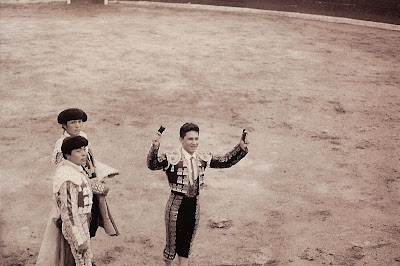
Nevertheless the fight went on. Colon knocked down his tormentor, Pascual Navarro, trampling him and buffeting from his shoes and hat. But Navarro was not injured. He rose, killed Colon cleanly and was awarded by the
presidente—the fight judge who sits in the stands—both the bull’s ears as trophies. Above you see him holding up the grisly prizes and beaming at the crowd. For the Americans in attendance, if there was some artistry to the battle or some satisfaction to be derived from being spectators at this ancient rite, they didn’t care. They were aghast, and by the third fight many of them had left the stands.
Three matadors, three messily slain animals. Each fight appeared identical on the surface, but in reality each differed in its details. Some matadors attempted maneuvers others didn’t. Some bulls fought better than others. But all the animals ended up collapsing bloodily into the dirt.
The last and best matador was a young man named Valente Reyes, who was tall and slender as a prince. He elevated the butchery to something more like art. He performed
pases rodillas—passes from his knees—making a bull named Mago charge and miss five times. He swung his
muleta—his cape—in arabesque patterns like an illusionist. The Mexicans in the crowd erupted at these maneuvers and Reyes stopped in the middle of the duel to bask in the adulation, handsome and arrogant, as the bull glared dully.

In fact Mago seemed all but defeated. So when, on the next pass, his horns sliced open Reyes’ sequined
traje, it couldn’t have been more shocking. White linen hung from a slash in the brocaded costume and the matador’s façade of mastery briefly dropped. But as a chorus of cheers rose up from Americans who had stayed—the Mexicans shook their heads in disgust at this display of disrepect—Reyes rediscovered his focus. He taunted the crowd with a gesture that said, "Watch now, what I do to this bull you cheer." It was plain to see that Mago would be made into an example.
Reyes took up a pair of gaily decorated
banderillas. Covered with paper flowers, these short, barb-tipped sticks spur the bulls on because of the severe pain they inflict. Reyes faced Mago. A quick pass and the
banderillaswere deftly stabbed between the bull’s shoulders. It roared. Another pass and two more
banderillasbristled from Mago’s back. The bull was foaming at the mouth. The blood and paper flowers and churning dust of the spectacle were all an abstraction by now. What I was witnessing wasn’t surreal or un-real, but heightened reality in which bull and man had become combatant-ambassadors for their species. It was the cruelty of all humanity I saw, and the rape of all nature.
The remaining Americans, even those who had protested, were mesmerized now by the grimness with which Reyes conducted his business. He walked with his last pair of
banderillas to the edge of the bullring and broke them against the
barrera, the railing. They were now half as long as they had been—and would be twice as dangerous to insert. Another thunderous charge and the harpoon-tipped sticks went into Mago’s hide.
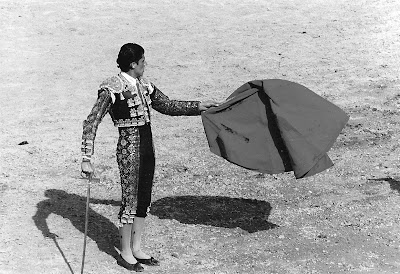
Mago had already proved to be a smart bull. He had backed away from the
picadores after being holed once, and it had been an unexpected but deliberate rotation of his massive head which had allowed him to nearly hamstring the agile Reyes. But in the next moment he proved just how smart he was. He looked around the ring for an exit. There could be no mistake about it. He made a half-circuit, staring at the
toreros, perhaps considering whether one of them would be easier to fight. Then he lingered at the spot where he had originally entered the ring. But there was no door there now.
Meanwhile Reyes had gone to his
mozo de estoques—his personal attendant in the narrow passage behind the
barrera called the
callejon—and retrieved his
estoque, his killing sword. The last act had begun. With exquisite patience Reyes incited Mago to charge. On the first pass his blade glanced off some bony cleft or other and fell to the dirt. Reyes recovered it and Mago wheeled about. A second pass and the blade missed the mark again. The Americans jeered and Reyes goaded them with a gesture from his upraised hand. He was angry again, and that meant Mago’s time was up.
On the third pass Reyes finally drove the
estoque in, high up on the bull’s back. Mago spun about from that last charge unaware that he was already dead. But the crowd saw the pommel of sword flush against his back and knew it was over. The bull’s heart had been pierced. Mago started to charge again, stopped. He paced about, bellowed loudly, and fell to his knees. A torrent of maroon aortal blood burst from his mouth and nose as if a faucet had been turned on. Reyes walked regally around the ring with arms aloft, pausing so that tourists with flash cameras could get good shots of his face. Mago fell on his side and stopped moving. Reyes earned two ears for his victory.
I knew from reading Ernest Hemingway’s
The Dangerous Summer—that blood-soaked classic about a season-long
mano a mano between two legendary Spanish matadors—that two ears were only half the trophies that could be awarded to a brave bullfighter. Reyes had probably earned those last two trophies—the tail and the hoof—a few times in his brief career. But as good as he was, even he would have been little more than a
mozo to the greats of Barcelona or Mexico City, those storied matadors who can kill a bull instantly with their swords, severing the spinal cord and stopping it in its tracks.
Hemingway rhapsodized about the festival of San Fermin—ocurring this last couple of weeks in Spain—in which the brave run with the bulls. He described a love for bullfighting that is remarkable in its lack of apology, especially eighty years later. Unlike portrayals in anti-bullfighting literature, he was fully aware of the cruelty of the sport, but saw it as a great human art in a chaotic and hellish world. In a world in which savagery is continually cloaked in artifice, it was the ultimate art, a truth in an ocean of deception. It represented a reality which he felt many were unwilling to face—that for us to hold on to our humanity, death must remain close to us, close enough to see and smell and hear, and at the expense of the bulls.
We are presumed by some to be the only creatures who are aware of death, of the void. This will turn out not to be true, as animal science continues its inexorable march, but in 1926, it was stone cold fact. Hemingway felt sorry for the bulls. But it was man's ability to cloak cruelty in ritual that impressed him. He described matadors performing tremendously artistic passes called
veronicas, mariposas, chicuelinas, and
remates. These were all techniques unseen in Puerto Vallarta. The most exceptional matadors even kneel in front of a bull and touch noses with it. No one in Puerto Vallarta would have dared such a thing. Vallarta is the minor leagues. But the
matador I observed—Valente Reyes—was young and ambitious, and might yet graduate to the great plaza in Mexico City. In a country where children fight bulls in pastures using t-shirts as
muletas, the craving for fame in the national sport provides considerable incentive to practice.
And so after the dust cleared and dead Mago was dragged out by his hooves, I wondered what I had actually seen. I wished I was in Pamplona. That was a given. But beyond that, did the animal agony I had witnessed remind me of the quality of suffering or did it desensitize me to it? Is tradition a justification for cruelty? And originating as I do from a land of carefully pre-packaged savagery, where a football knee injury is considered mortal and
mano a mano is when two hockey players square off to beat each other up, can I criticize this sport that does more than just
simulate death?
Some days later I described these events to a friend, and told him he should experience a bullfight one day. He said: “If I want to experience a bullfight, I’ll just go out in my back yard and stab a puppy.” It was a curt reminder that, poetic or not, a bullfight is simply mythic, organized slaughter. But nothing I’d seen before, particularly nothing in sanitized American sports, ever affected me as deeply as did the deaths of four Mexican bulls. And it made me think about things no boxing match or pit fight ever caused me to consider. I wonder if that isn’t the sole reason the practice has survived so long.
Perhaps the strangest part of it all is that the
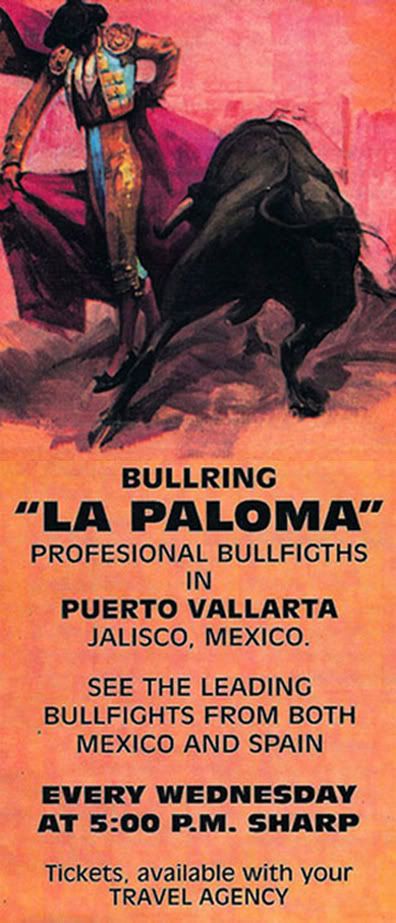
plaza de toros in Puerto Vallarta is called la Paloma—the Dove.
Labels: bullfight, hemingway, mexico, pamplona, san fermin
 When the first bull charged swift and irate into the bullring his power was so palpable I pictured him as some mythic beast—a minotaur or perhaps some monster from The Iliad. The fifty men trapped inside with him melted away from him like he was radioactive, climbing the perimeter fence each time he bore down on them and then dropping back into the ring in his wake. This was a Guatemalan rodeo—a chaotic hybrid of a Stateside rodeo and a Spanish bullfight—and it was audience participation all the way. That meant the thrills and spills were going to be provided by everyday townspeople. It was improv rodeo where the trick was to face down an angry bull and escape alive.
 But the spectators cheered for action, so before long one bold soul succumbed to the pressure. He took a stance maybe fifteen feet in front of the bull and did a disjointed dance that got the crowd laughing. And then everyone realized the guy wasn’t brave—he was drunk. While a drink or two has been known to improve one’s darts game, tipping a few before facing a bull is a good way to eliminate yourself from the human gene pool. The guy got twenty seconds into his routine, and then the bull charged almost perfunctorily and nailed him so hard he nearly rolled out of the corral.
 A few minutes later bull number two charged into the ring and the crowd was treated to its first gringo appearance. Joining in on this kind of fun was pretty much established as an American tradition when guys like Ernest Hemingway and John Huston documented Spain’s Festival of San Fermin. Huston’s autobiography, An Open Book, features a photograph taken of him being nearly vivisected by a bull after he jumped from the bleachers of a Spanish plaza de toros waving his suit jacket. A few years ago Spike Lee reminded people of tradition when he filmed a Nike commercial featuring himself running with the Pamplona bulls. So foreign participation was no problem for the people of San Antonio—in fact they seemed to expect it.
 By bull five the perimeter fence was collapsing in three places and workers were scrambling with fresh rope to make repairs on the fly. Lightning licked nearby but the people in the pine trees weren’t about to give up their spots. The last two bulls had been disappointing and everyone wanted action. One man stepped forward with a towel and made the bull whiff half a dozen times. But there was a reason he was in San Antonio rather than in a plaza de toros in Barcelona and everyone found out why when the bull finally caught him. Amidst a chorus of screams the guy went down hard, got trampled and just missed having his delicate parts mashed into cracker spread. He was carried out of the ring incapacitated and bleeding from his nose. Since I don’t think he actually got hit in the nose, it was a pretty bad sign.
 And it was a good day for the bulls too, considering the alternatives. Not only did they make it through the rodeo without being tortured and impaled, any spectator would agree they had won every fight. Divest a man of his swords, saddles and spurs, and it really evens up the odds. No bull ever won the by-the-book bullfights I’d attended, and the horses and calves in the North American rodeo I once saw weren’t exactly bleating a happy tune. Which in my book makes the Guatemalan version better, and the Guatemalan participants braver, than any cowboy or matador