Getting Medieval in Guate

My former home country of Guatemala has been popping up in the news quite a bit lately, for all the wrong reasons. First there was the giant sinkhole that swallowed half a dozen houses, quickly followed by last week’s 6.8 magnitude temblor. But those were just warm-up acts for the astonishing headliner. In the frontier town of Camotan this week, a mob numbering 2,000 people attacked three women on suspicion they had killed a young girl and stolen her organs to sell them. The missing girl—nine-year-old Mishel Diaz—disappeared from her home and was discovered a day later, mutilated and abandoned near a little-traveled dirt track. Reports said her arm was cut off, her eyes gouged out, and the skin on her chest removed in what looked like an attempt to steal her heart and kidneys.
In short order an angry mob, comprised of what witnesses say was the entire population of Camotan, went house-to-house looking for the three women they believed were last seen with the girl. When the crowd found 24-year-old Marciana Recinos, who was one of the suspects, they bludgeoned her to death in the central plaza using rocks, sticks, and plain old fists. Police rescued the other two women but only after the mob pulled a Mr. Blonde on one—dousing her with gasoline à la
Reservoir Dogs and setting her on fire. The other woman, pictured below in a posed police photo (a uniquely Guatemalan tool for dispensing info to the local press) is currently safe in jail.

As bizarre as this story probably sounds to people who have never visited Guatemala, the fear among residents of their children being stolen and harvested for organs runs deep, particularly among rural Mayans. The fear has taken on the character of folklore, with most swearing it has happened to the daughter or son of a friend. I heard the stories firsthand, but in reality there is no substantiated proof of organ harvesting there.
But the danger from incensed mobs was well known among us expats, and we never shot photos of children without explicit permission from the parents (good manners in any case, but a potential life saver under those circumstances). My friends who visited, all of whom were first timers to the country, sometimes snapped photos of children and I always warned them to be careful—usually while distancing myself from the scene. In 2000, a Japanese woman was beaten to death for photographing a child in the town of Todos Santos, and her Guatemalan driver was burned to death as her presumed accomplice. I walked into the aftermath of a mob killing myself in 2004, and I also saw police photographs of mob victims, including one of a man who had been hacked to death with machetes and his head doused with gasoline and burned down to a blackened skull.
News reports on the latest incident all say that distrust of the police is a factor in vigilante killings. That’s true—local police are considered corrupt, and the general feeling among the Maya is that inviting them into their communities is to court disaster. They are not unique in this belief. In poor communities the world over—including in the United States—police are believed to hinder rather than dispense justice. In Guatemala, rural townsfolk prefer to handle arrest, judgment, and sentencing all at once. But in the case of little Mishel Diaz, her death seems far too clumsy to be a bona fide attempt at organ harvesting. There’s no word yet on post-mortem findings, but what seems equally plausible is sexual assault followed by mutilation as an attempt to disguise the true nature of the crime.
Usually when newsworthy events occur in Guatemala, I can find out details that didn’t appear in the press simply by e-mailing my old circle of friends. But cases like this are different. The Maya are a closed circle all their own, a mystery even to other Guatemalans, and police are not motivated to investigate when the people involved seem satisfied with the outcome. I doubt the truth will ever be known.
Labels: camotan, guatemala, travel
Prague Spring and More Absinthe

I promised myself no more absinthe, since this was my second visit to Prague in this lifetime. This time around, I wished to explore the capital of the Bohemian kingdom a different way. Already saw the castle and the cathedrals and every beer cellar over 500 hundred years old. Good things, no doubt, but this time around I needed to feel something a bit more modern and day to day. So I only had one beer on the plane, and made it to the Charles Bridge from the airport via bus and metro, all by myself. Feeling like such a big boy, I went on to meet up with my Helsinki mate who'd extended the invitation, and started sharing time with some new characters.
Actually, the first night of the trip, I did see Stan the Man rip up the guitar at
Glen's again. But that's what you do on a Monday night in Prague, and the cellar was packed with locals, travelers, expats, and tourists alike. I also haunted a few pubs and cellars I had before, and I did stroll across the Charles Bridge more than a few times. But this time I had local rabbit and moose paté, as well as the usual cabbage soup or goulash. Definitely did not shy away from drinking beer with lunch. This is Bohemia after all, and Staropramen and Pilsner Urquell remain great draws. They may not run as cheap as 50 cents a half liter anymore, but about 1 euro on average does not make me cry. But spring fever does make want to me cry—all the way to church to thank god, any god, for excellent work in the continuing evolution of gorgeous beer maidens.
So back to the topic at hand. On May Day, had moose paté, followed by farmer's dumplings, sauerkraut, with a bloody mary to start. As a recovering barman, I always appreciate the classics, and this lunch establishment delivered a good, balanced, breakfast of champions in a glass. I finished the paté, then we heard it. Boom. Yep, that was a smoke bomb, right outside the front door of the restaurant. I noted excellent timing on our part, since we had drinks on the table, some nutrition in our stomachs, and a round of beer on the way.

Then the tourists made themselves obvious by approaching the window to take pictures. But in my experience political rallies are often on the edge of becoming outright riots, so I'd learned to stay away from the windows. A girl who sat at the table with me and my friend said it must be the anarchists. Sure enough, the kids were running around the street without any order of procession, setting off another smoke bomb. With colorful hair, piercings, and discount tattoos everywhere, they were ready to make their statement.
And here came their cause
du jour—the fucking neo-nazis had organized a march, complete with police escort. I knew this looked worse than reality. I
hoped it looked worse than reality. Anarchists never deal with the law, and nazis need order like a toddler refusing to wean; therefore, it appeared the Czech state goons, er, officers, protected the skinheads and pushed away the street punks. This modern spin on
Quadrophenia (or was that
West Side Story?), capped off quickly. The actors had their motivation, yet knew nothing about getting out of character. The tourist table next to us took a picture of a punk urinating in the street between two cars.
We skipped dessert.
Willing to wait out the battle between dumb new order and even younger chaos, we sipped our beers and made prudent plans. We would stroll through parks along the River Ultava, then find a cool beer garden we hadn't seen before, sit down, drink beer, and observe. Enjoy Prague in spring. My friend figured he could call up some old friends to join us. Since they were all struggling artists, they were waking up in the early afternoon, and had no problem having one or two beers before work. They just needed time to gather up the courage to go outside. Our friend who brought us to lunch had to run off to work, and suggested we meet up later at the pub for the Liverpool/Chelsea match. Funny thing about Europe, no matter where you go, football goes on.

Sitting on a terrace of an old flour mill, we enjoyed feeling the Earth rotate in the universe. Some of the locals and expats told me how Prague is mainly an atheist society. Funny, I could understand maintaining a large community as generally secular, but I never heard anyone say this is all atheist. But I noticed the cathedrals and synagogues are concert halls more often, and people do not attend mass or temple in droves as in Mediterranean countries. Bohemia commanded a different kind of pilgrimage.
The beer maiden came to the table with another round, and I had to find a god again, any god, just to give a nod, a thumbs up, more acknowledgments for nice work. As I walk my path to hell, any hell, I like to try and make out the local graffiti and figure out how people express themselves. Prague is the film capital of Europe, due to the low costs of location shooting and extensive experience in theater, it seems. A local helped to translate a few things which seemed to be out of Robin Hood. The stuff in the bathroom seemed somewhat more political. Quite a great place to take one's time for political expression. As we moved on to the pub to catch the football, I reflected on the day. May Day in my hometown of Helsinki has a different vibe. Then again, many things have a different vibe when compared to a spring afternoon in Prague. The grass, the leaves, the flowers, and the aroma cannot compare to anything else.
Time for another beer, and we hit the pub, missing the kickoff by about ten minutes. Not a thing to worry about, since friends of friends I just met had a few chairs free. The beer came to the table at a casual pace, but on a busy night, I could never get upset over casual service. When in Bohemia, start drinking early. Everything works itself out after that. We chatted about football, travel, and another place we should check out after the match. Turns out they had some good graffiti, and the actors I had met before would end up there after their performance or rehearsal or whatever.
When we got to the next bar, it was late and I wondered if they would serve us. I forgot that we were in Prague—service continues until you pass out or turn asshole. I met some new best friends, and one told me this was a dangerous bar. I noticed everybody was friendly, and asked what made it dangerous. She smiled and said, "You'll find out."

Perhaps my reputation preceded me.
I found my way to the toilet, somehow took more pictures of graffiti with my phone. Back at the table, somebody suggested something strong for a toast, since this was an excellent spring night, followed by an excellent spring day, and this summer was going to be the best. The Czech girl I had just met reminded me, "Like I said, this is a dangerous bar."
Realizing what she meant, I said, “How about some absinthe?”
I made it back to my room that night, worked all three keys through all three locks perfectly, and woke up on a spring morning in Prague. Some clichés grow from true experience. Bohemian life, I dig it.
Labels: prague, travel, u maleho glena
Last Night in Rio

I woke up the next afternoon before the sun went down. I'd made a choice after the beginning of the trip, and realized late parties would prevent any chance of appreciating Rio under the sun. I missed breakfasts, lunches, and all of the basics most people enjoy during daylight.
I opened the mini-fridge in the apartment, found only water, juice, and crackers—no beer. For once, I felt relief finding the fridge without beer. We had partied the past ten nights and early mornings. Time to slow down and soak in the city. The guys collected without many words until I asked if I missed anything after leaving the
esplanade the night before—no, wait, that morning, or . . . damn, head hurts. Where the fuck are my shades?
Wondering aloud what to do the last night of the trip, the boys handed it over to me. Your choice, Ari, lead the way. Step one—sandals, wallets, and keys. Step two—hand our room keys to the staff at the front desk with a casual nod and smile. Pointless to say good morning at sunset. Step three—quick stop at the store across the street to grab a big bottle of water for a walk to Copacabana. We'd already begun strolling downhill, so gravity narrated the rest of the tale for the evening.
Just stroll with the flow downhill, and we were pulled right back to our regular locations. We headed straight to the same terrace of the same restaurant, with the same professionals pulling out chairs and arranging a table for us. Don't recall what the other dudes ordered, but I asked the waiters for suggestions along the line of
mariscos, and dined on fruits of the sea I'd never seen, studied, nor dreamed. I thought about one last
caipirinha, but no need for that. Just beer,
sangría, and water sufficed.
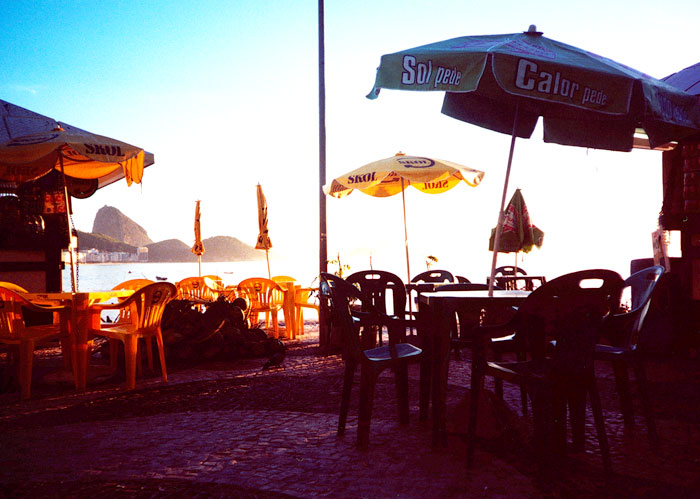
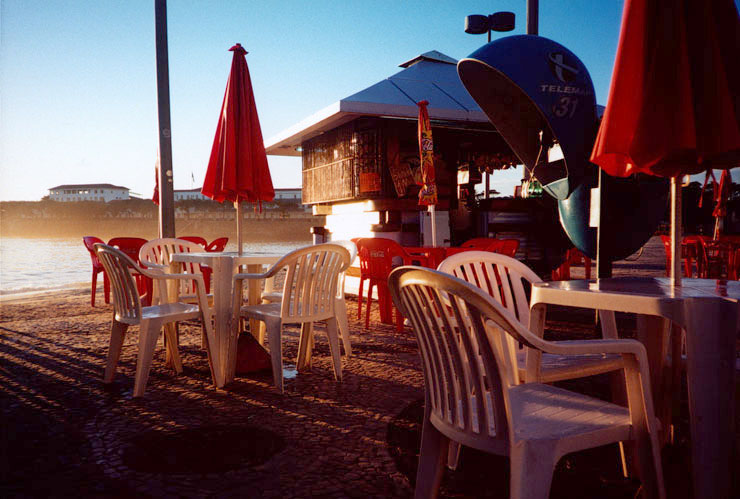
A special peace settled on the streets and beach of Copacabana that evening. No hurry, I just wanted to soak it all in. Skipping dessert and coffee, we strolled across the street to our regular
baizharinha. I would hesitate to label us regulars, since we only visited the location for ten days and nights. The people offering service and the locals hanging out alongside made us feel like we were sharing a community living room.
Then the band appeared. Never noticed them setting up, only felt the drums and heard the guitar strings. I wondered aloud if someone had a good stereo in a taxi passing by. Then I wondered aloud if it was an
axè, or one of the other Brazilian genres I noticed in a local music paper. Then Doug asked why I always wonder aloud.
The rhythm, the melody, the tune, and the atmosphere all felt exactly like what I expected for a Rio experience. This was why we ran around the town in a taxi trying to hunt down the spots we discovered in every travel book, rumor, and website. All along we had no need to hunt for anything. We only had to wait patiently, take it easy, and Rio brought us what we wanted.

The bossa nova hippies played on, and we chatted with one of the dudes who was picking up cans for income. I asked if he could drink on the job, and he laughed. So I bought him a beer. The one musician who played some funky mix of bossa nova and reggae handed his guitar to the sound man. He walked right over to us and smacked hands with a snap and a knock. We stood stage left, so he probably had a good view of us kicking back and digging his music for real, something unique and forceful we'd never experienced, but which we knew waited for us in Rio.
Sabrina, our favorite waitress, laughed at us travelers trying to revel in the local cool. The soundman took the stage, and the locals began shouting out requests. The guy looked like a generic middle-class old guy who would fit in better on an American softball team. He fomented the emotion of the people as they all danced and sang along with the music of their lives. I had no idea if he played standards or modern hits of bossa nova or folk songs, but the people enjoyed the vibe, and we felt good.
But the musicians could not play forever, and we could not stay much longer. We had plane tickets and stupid jobs back home. We were travelers, picking out our clichés of choice. The band possibly moved down the beach to play for another crowd of revelers, or simply headed home. Sabrina sat down with us after the crowd left, and shared some details about her life. She lived alone, somewhere in the
favelas. All of her family lived back in the
nordeste, Northeast of Brazil. I forget what town or state she mentioned, but knew it must have been more remote than Recife or Salvador d'Bahia.
I expressed my emotions as best I could, and the boys encouraged me. I said no way, not cool. But these cats have a pact to indoctrinate new friends into their fold by pushing them into doing something out of the usual mode. Egan, Doug, and Steve built an Egyptian personhood of sorts while in school in Colorado. They choose hieroglyphs rather than Greek letters in order to differentiate themselves from the frats and sors—fish-eye-guy going like that. . .

Feeling bitter, I took the push and asked Sabrina out for a dance after she checked out of work that night. She told me she was only going home to sleep alone, so nothing was going to happen. Unhappy getting pushed into that corner spotlight, I wondered aloud for another round of beer. Nobody refused, so we enjoyed our last white sunrise in Rio. I'd traveled there looking for nothing less than an epiphany, a life changing experience in a legendary city, maybe meet a woman made of dreams.
I must admit I fell in love with one of the Finns we met on Copacabana the sunrise of Ash Wednesday. I moved to Helsinki the next year, and eventually met my Finnish family I had never had much contact with previously. The relationship did not work out, but my life in Helsinki goes on. I have my friends, family, and contact with the planet Earth I could never feel in California. I now have certified world citizenship. I demanded a life changing experience from Rio, and she delivered as promised. Blame it on Rio, baby—she can make it all dance.
Labels: brazil, copacabana, rio, travel
A Bright White Sunrise, Part 2

What Ari wrote in his post "Finally Scored Some Shades" is true. I threatened to kill the bloke from Southampton. I don’t normally threaten people’s lives—in fact, this was the only time that I can remember doing it. But this primitive character, who looked like he probably gutted sheep for a living, took such joy in dominating a prostitute that I thought he should experience a little domination too. What I told him exactly, was to look into my eyes and tell me if he thought what I next said was a joke. Then I explained to him that he was sixty seconds from the end of his life if he didn’t apologize to the woman. I asked him if he believed me. He said, “I believe you, mate.” And he apologized.
Thinking back on it, it was inevitable that I’d try to take a stand, however futile, against this particular niche of capitalism that makes whores of us all. And as with the boy who I lectured for pissing on another boy’s face, I don’t think the Southampton bloke learned anything. I sometimes ask myself if I really would have killed him. All I can say is that I meant what I told him. And in the midst of our standoff I whispered to Doug: "Do not step in no matter what happens." But as it all unfolded, the hooligan understood what was in my eyes, and he got the hell out of there. I never saw him again.
That morning of the bright white sunrise was my last Rio encounter with the Finns too—they were flying out the next day. But my friends and I had finally discovered the Copa kiosks, and they were our home now. Each had a particular character—some were social and some were for quiet reflection; some were international and some local, some had live music, and some were just for drinking the night away. The carnival was over, and hundreds of thousands had returned home. A hurricane had passed and the sun had returned to Rio. Storefronts that had been sealed with corrugated riot doors lifted to reveal beauty salons and butcher’s shops and stationery stores. The street where we were staying in Arpoador took on a pleasant neighborhood feel—no different from a block of midtown Manhattan.
Doug and I visited Corcovado—just the two of us. It was a sunny day, and the park was crowded. Scores of tourists were taking photographs of the famous statue Cristo Redentor. I wandered around and sought a shot that didn’t look as if it came directly from a postcard. A small cloud sped across the mountaintop and I saw dozens of cameras lowered as their owners paused, waiting for the sun to return. In that brief few seconds I raised my camera and made the shot at the top of this post. I have never seen another photo of Cristo Redentor like it.
Rio changed all our lives. We learned what it truly was to immerse ourselves in another culture, to buy airline tickets on a whim and just fly away. We have since visited—together or separately—places like Reykjavik, Budapest, Dublin, Puerto
Vallarta, Lisbon and many others. There have been countless adventures—Ari was once held hostage in a Budapest strip club; I once rode stormy seas smuggling two wild animals onto a tropical island. Ari and I actually did see the Finns again—six months later when we flew to Helsinki to meet them. Only a few months after that I moved to Guatemala and Ari left the United States too. But Doug’s story is probably more interesting than all ours.
Arriving as he did, days after his father's death, the trip was a chance to shed his entire bad history. He attacked Rio with an intensity that astounded me. He danced and drank with ferocity, laughed and joked like a madman, and everybody who met him loved him. He broke every rule of safety imaginable, from passing out overnight in a Rio gutter to scoring drugs from shifty street hustlers. He was invincible. He simply knew nothing bad would happen to him. After I moved to Guatemala I tried to get him to come and visit, stay for a few weeks or even months. But he could never quite manage it. And then a year later Steve passed word along to me—Doug had committed suicide.
We discussed why, and we all had opinions. I think his family drove him to it, and I think in the midst of all their negativity the invulnerability he felt in Rio was impossible to hold onto. But in the end it doesn’t matter what I think. Though god and country would have us believe otherwise, each person’s life is his or her own to do with as they wish. Only Doug knows the reasons for choosing to end his existence. But as a friend, I trusted him with my life, so it pretty much follows that I trust him with his own. I support his decision, even if I disagree with it.
There is a world in my mind where Doug still lives, and in that world, there is only one city—Rio de Janeiro. The same sun rises over and over, bright and white as burning acetylene, and "New Year's Day" is playing. The photographs I took, some of which are below, don't seem to originate from any terrestrial place, but rather from deep space. They are like fragments of interstellar static assembled to form images of events that occurred billions of years ago. And that’s how I’ll always remember Rio—as an instant in eternity, a flash from the other side of the universe, gone now save for a few shards of color so beautiful yet so weird it’s difficult to say whether they ever really existed. I guess that's how I'll remember Doug too.
Labels: brasil, brazil, copacabana, rio, travel
Avenida Atlantica Vice
 Every customer comes with those bulging, moist, expectant eyes of a man who has escaped from his prison for a week or two. It may be the puritanical monotony of the working week that drives the men to seek relief: not raging bulls, exactly, more like cows waiting to be milked.
John Burdett
Bangkok TattooOn night four we went in search of dinner and ended up in Copacabana. We’d had some great adventures so far, only some of which I've described. In short: three allnighters, an excellent street party, two meltdowns, a near-death experience, and a gas-filled apartment that—in a building full of smokers—did not explode. All typical vacation fun. But on Copacabana’s Avenida Atlantica on Sunday night, near a disco called Help, we walked into ground zero of a citywide vice explosion. There were scores of outrageously dressed women. I’m talking bikinis and high heels, red capes and devil horns, negligees and fairy wings, and countless miniskirts that revealed more ass than they covered. Professional girls, these? Indeed. In fact, we had wandered unknowingly into one of the most famous hubs of the global sex trade.
There was an outdoor restaurant called Sobre as Ondas right next to this scene—we snagged four chairs and rubbernecked while eating dinner. The Avenida was the floor of the New York Stock Exchange and Bartertown rolled into one. The whores were magnificent, and came in more varieties than simply the nearly naked. For instance, see that girl riding a skateboard and wearing baggy camo fatigues? Yes, she’s a prostitute. See that perfectly coiffed woman wearing a business suit and carrying a briefcase? Yes, she’s a prostitute too. The meter maid? Her too. The Brazilians had taken the oldest profession, added a dash of niche marketing theory, and frappéd them into a moneymaking miracle.

Music, singing, and drumming were constant. The street crackled with the energy of a high-tension line. There were hard and fast negotiations going on everywhere—I mean serious business, with frowns and demands and counteroffers. The men involved were mainly of a certain type—those so steeped in sexual ineptitude that people could almost see it stamped on their foreheads. But the rules of the sex trade gave them control. Female free will had been abolished. Two-hunded bucks in pocket now equated to superheroic virility. These men whistled, shouted vulgar come-ons, and generally behaved exactly like losers given carte blanche in a sexual Disneyland.
Amongst this throng Doug, Ari, Steve and I were clearly non-participatory—other than the fact that we were having a great time just watching. I’d say twenty percent of the men were chill and seemed to have their shit together. The rest were problem children from north of the equator somewhere, and just like the Brazilian water supposedly went backwards down the drain, Brazilian hookers were going to reverse every failure and blow-off they had ever suffered. For their part, the girls made their preferences clear—they flocked to the non-predatory guys, including us. It made sense—if you’re going to fuck for money, first try the guys whose eyes aren’t spinning like the reels on a slot machine. No need to service some overwrought social misfit if you can avoid it.
We made it clear we didn’t want to partake in the wares, but that we didn’t mind the company. Several girls joined us after Doug gathered some chairs (he may have been browsing at this point, but I’ll get to that in the next post). There were two types of girls on the stroll—year-round pros, and opportunists. The pros had no time for nonsense, no time for socializing.

One of them might pretend for a minute to be friendly, but soon she’d segue into her pitch: “Serious now, handsome, you wanna party with me or what?” When we said no she’d leave fast enough to burn rubber. The girls who sat with us and stayed were the second breed—opportunists. They had plenty of time to shoot the breeze because they didn’t consider themselves hookers. One of them laid it out for me: “I work all year up north in a store and make like three-thousand dollars. I come here for carnival and make three thousand in a week. What would you do?”
We bought pitchers of
sangria. Girls rotated from our table and others replaced them. There would be a few whispers traded as our companions presumably informed the newcomers: “These guys? No, they’re not buying pussy—just drinks. But they don’t mind if you join them.” Occasionally one of the girls might doublecheck our intentions: “Have you changed your mind yet, baby?” But generally they didn’t pressure us. Why would they? Why would they waste their time when the street was jammed with men eager to ransack their bodies? The ones who decided it was time to sell simply left. The ones who wanted to socialize stayed. And we all laughed like we were at a frat party as the ancient spectacle of sex-as-commerce pulsated wildly around us. We spoke Spanish and Ari had a little Portuguese and we were communicating fine.
Rio’s year-round pros are into volume, while the opportunists are about quality. They don’t want to have sex with twenty men during carnival then go back to their secretary or hostess jobs up north with what they perceive as a lie in their hearts. They’re hoping for the most benign of johns—the Canadian who would never cheat on his wife but wants dinner with a beautiful woman and is willing to pay for the company. Or the German who will buy her for ten days straight—twenty fucks from one stranger translating to something more forgivable than the alternative. Forgiveness is an important part of the milieu, keep in mind, because every one of these girls is at least nominally Catholic—which means they’re expertly schooled in the art of burdensome guilt. To avoid that guilt, they will stiff you in a second. They’d rather run off with your money than go through with the sinful deed. How much money they can make without actually ending up on their backs in a hotel room is another of the many games played during carnival. And yes, free drinks are part of it too, so perhaps they were working us as well.

Just a few doors south stood Help, which Ari mentioned last post. Travel guides explicitly warn to stay out of the place. It's the largest disco in South America. It was closed at the moment, but many of the people on the Avenida seemed to be waiting for it to open. We asked our girls about it. They said the place was great—wonderful music, strong drinks, all night dancing. We filed that away. Quarter after midnight or so Help opened and half the people on the street poured inside. Our girls said farewell and we were alone. We took a survey—continue to relax and enjoy the spectacle on the street, now considerably diminished, or go to club Help?
Labels: brasil, brazil, copacabana, prostitution, rio, travel
A London New Year's that Wasn't
Buddhists and quantum physicists will tell you with utter certainty that time is an illusion, but I believe counting the days has concrete rewards, and that New Year’s celebrations are one of them. Although I’ve been fortunate enough to be stationed at ground zero for some of the biggest parties in the world—from SXSW in Austin to Carnival in Rio—I’ve never really celebrated
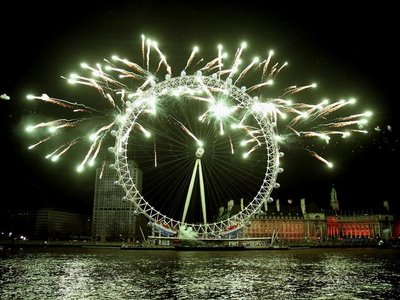
western New Year’s in grand style. On two occasions I was in the Caribbean, on three I was in Los Angeles, and I spent one uneventful New Year’s in the coach section of a United flight from Spain, pathetic as that seems. But I’ve never rung in the New Year with fireworks, champagne, and a hundred thousand people screaming, dancing, and swapping kisses.
This year I decided London was the ticket.
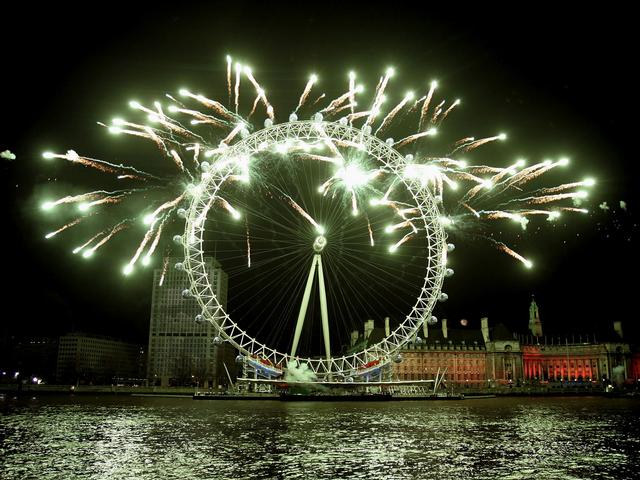
London’s official celebration, a gargantuan fireworks display that draws multitudes, takes place on the River Thames with the famous London Eye as the backdrop. I really meant to attend this event, but a funny thing happened on the way to London—I ended up in Hastings with friends. Clearly Hastings is no London, however it is historically significant. As anyone who retains a sliver of high school history somewhere in their brain can tell you, it was the site of the Battle of Hastings in 1066, the most decisive Norman victory in the Norman conquest of England.
On October 13th of that year a French army led by William of Normandy clashed with English warriors led by Harold II. There are numerous conflicting accounts concerning the battle, but the long and short of it is that the English lost the next day after Harold was killed. Some versions have him cleanly slain, while others have him felled and subsequently decapitated, de-legged, and de-everythinged by the savage French, who apparently intended to dice him up for mauviette pie. My friend Davis (not his real name) summed the entire event up in a deadpan I found quite comical, though I’m not entirely sure he meant it that way: “They fought, Harold was killed, arrow in the eye, French win.”

These days Hastings is a beachy seaside town, heavily trafficked in summertime by London tourists. My friends had in mind a New Year’s pub crawl, but as often happens with pub crawls, we lacked the will (and coordination) to continue after bar number two. So while masses of hearty souls braved chill temperatures to watch fireworks detonate above the London Eye, I was in a pub in Hastings, where the last fireworks were in 1066. While I didn’t have the Eye or the pyrotechnics, I did have excellent company and saw several men you’d think would possess more dignity reenact the stripping scenes from The Full Monty. Lacking the French killer instinct, I couldn’t muster the nerve to photograph their doughy cavorting. But my girlfriend, bless her evil heart, felt no such qualms.
Sometime in the deep a.m. the festivities shifted to Davis’s (still not his real name) and his girlfriend Naomi’s (op.cit.) flat and evolved into an all night drug party, which is why I’m not using their real names. This was something of a surprise, even though the last time I saw the two, Davis dosed me with what he called a “Jesus cookie.” It’s a funny story, actually. He asked me if I’d like a Jesus cookie, but I only heard the word “cookie.” It tasted like a regular cookie. Forty minutes later I achieved geostationary orbit approximately 350 kilometers above the planet.
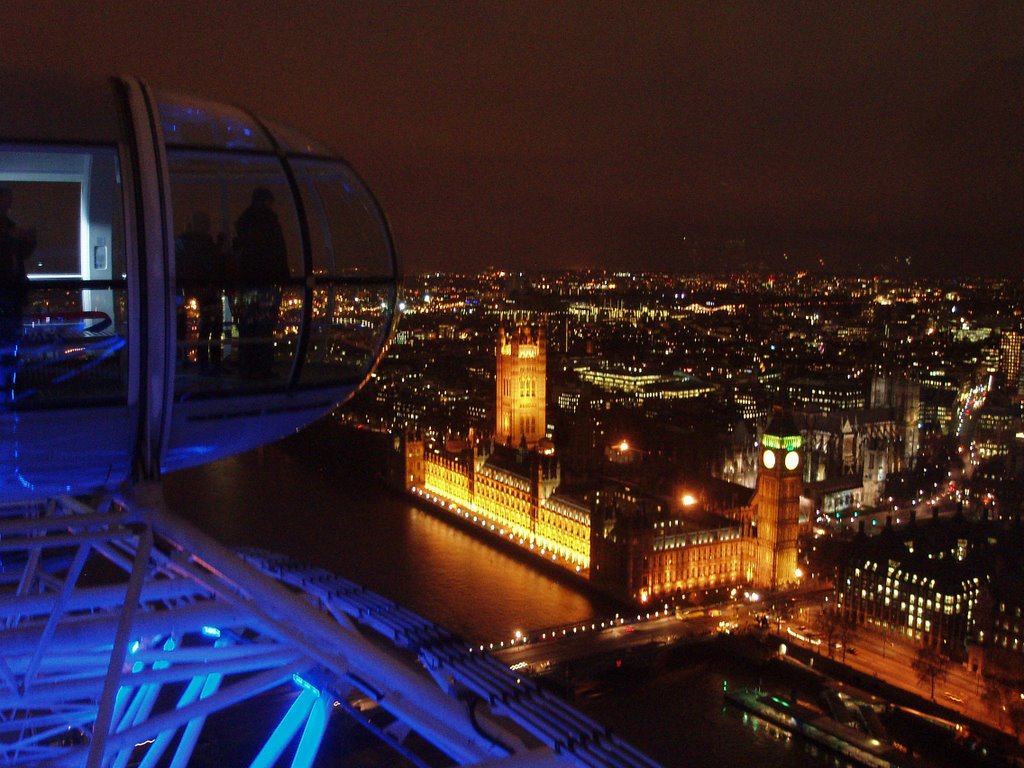
Two days after Hastings I found myself in London, too late for the fireworks, but not too late to sip the dregs of New Year’s by riding the London Eye. While my friends waited patiently below, my girlfriend and I went up for the bargain price of fifteen pounds each—about sixty dollars total, folks. Still, if the chance arises to ride this marvelous contraption, I recommend it. The Eye is an engineering miracle, unlike any other ferris wheel in the world. The view from the top is what you’d expect,
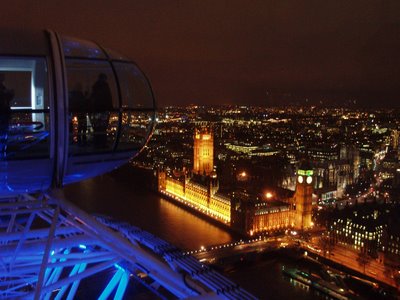
with London laid out like electric embroidery from horizon to horizon. But as beautiful and gaudy as the panorama is, and as spectacular as the New Year’s fireworks must have been, I’m certain nothing could have been more entertaining than the night in Hastings with friends (and their drugs).
As for attending a big league New Year’s party, I guess I’ll have to try again next year.
Labels: hastings, london, london eye, travel
St. Pete’s Wicked Ways
I recently stumbled across an
article on
Vanity Fair.com written by one of their many editors—Victoria Mather. The article was about St. Petersburg, Russia, and read like jacket copy for a romance novel. Vanity Fair employs some of the most talented English-language writers on the planet, but somehow their travel dispatches are always a little limp. None of them dig deeply, get to the heart of matters. They are content to describe peaceful scenes lit by lamplight and filmed through star filters. In the foreground you see couples kissing chastely under a bridge as boats drift by. Perhaps VF publishes these sorts of stories because their readers are well-heeled boomers whose yen for adventure passed with their last gallstone, or perhaps it’s because the brand is owned by Condé-Nast, travel publishers extraordinaire. But still, for a magazine with VF’s investigative reputation, this travelogue style reporting is a little disappointing.
Russians don’t kiss under bridges much—those places are the domain of black marketeers who sell western goods at a tenth the price charged in the United States. Russians love their nation, but the weakness of their tattered old ruble means their chances of getting ahead are enhanced by a mattressful of dollars or euros. It’s technically illegal to accept them for retail services, so subterfuge is needed. When I was there several years ago I hadn’t yet exchanged my currency when dinnertime came around, so I looked specifically for the magic Visa symbol in restaurant windows. At the restaurant I chose the credit machine was broken—which none of the staffers bothered to mention until after the meal. Clearly this was deliberate.
The waiter faked embarrassment about the mix-up, and then asked, “Would you happen to have dollars, sir?”
Well, it just so happened I did. I reached for them.
“Not here, sir—in the back.”
We retired to a dim corner at the rear of the restaurant. After he twice showed me with a calculator that he was not cheating me, I paid the ruble-tabulated bill with dollars, thus helping stiff the central government of the tax they would collect if there existed an electronic record of the transaction. I felt like I was in a spy movie. And then I realized—in a sense, I was. Being in St. Petersburg was like playing a bit part in a John Frankenheimer film—the role of Oblivious Diner #3, who appears screen right and exits screen left without ever noticing the protagonist and villain at centerscreen swapping a cash-filled briefcase for a microchip.
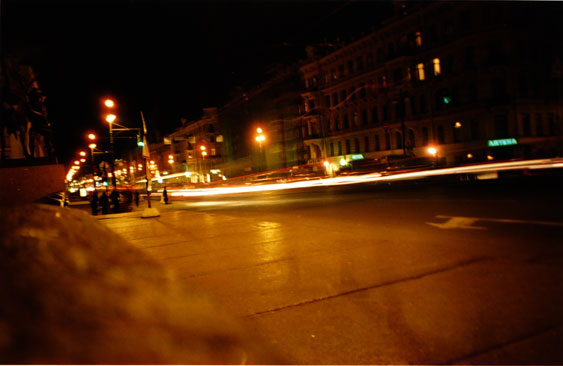
When capitalism flooded through the cracked Iron Curtain, the Russians who fared best were those ready to embrace true Western vice and rob their brethren blind. An entire gangster elite rose out of Soviet ashes. Pyramid schemes, American porn, and high-grade Amsterdam ecstasy abounded. Beautiful prostitutes paraded openly along the Nevsky Prospect. Electronic piracy made instant millionaires—they drove Jeep Grand Cherokees and Mercedes coupes, and bought boxes at Petrovsky Stadium to cheer on Zenit FC. They were above the law—in the busiest sector of town someone brought to my notice black-on-black Russian Mafia cars parked on the sidewalks, as a meter maid ambled past and instead issued tickets to vehicles sitting at expired meters.
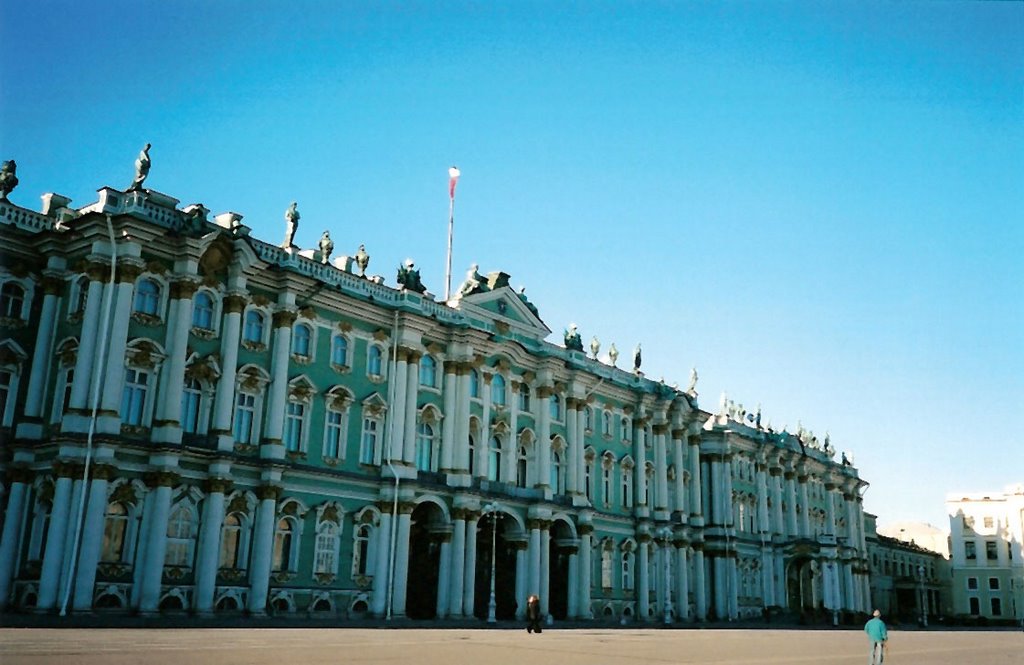
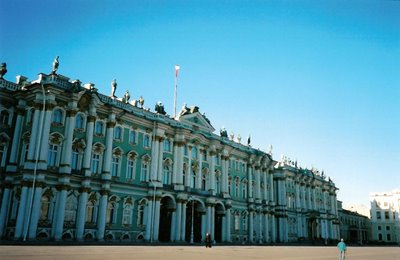
An underground railroad funneled contraband art and artifacts to wealthy Western collectors. Rumors abounded that the State Hermitage Museum (pictured below), one of the largest art repositories in the world, was being looted. This likely had been going on for decades, but the arrival of capitalism made art theft much more lucrative. The museum was supposedly bleeding masterpieces—seemed all you had to do was walk past and a priceless artifact would drop into your arms. Officials were tight-lipped about this for years, but when thieves skated with 221 precious items in July 2006, museum director Mikhail Piotrovsky had no choice but to acknowledge the theft. He said it certainly had been an inside job. Piotrovsky commented: “The presumption of innocence and the atmosphere of absolute trust in curators that has reigned in the museum in the past will have to change. The new economic reality has affected how people think, and money has begun to play a greater role.”
One of the missing artifacts was recovered in August when police received an anonymous call pointing them toward a garbage bin outside a building on Ulitsa Ryleyeva. They arrived to find an icon worth $200,000 sitting in the trash. In art circles the rumor mill revved to overdrive. The Hermitage, which houses more than three million pieces, was simply unable to keep a close watch on the entire horde. Thieves got the message and more heists followed. September 2006—five more works go poof, including a crystal flagon adorned with a crown holding 300 rubies and 24 pearls. December 2006—a female custodian foils yet another theft by grappling with a man who had broken a glass case with his elbow and tried to escape with a valuable ladle. The whole situation seemed right out of the Pink Panther. To be complete the story needed only David Niven climbing the Hermitage using suction cups.
Even the Case of the Irradiated Sushi—now playing on the international stage—connects to St. Petersburg. Italian newspapers reported that Mario Scaramella, a security consultant who has helped Italy's parliament investigate Cold War-era Soviet espionage, met with Alexander Litvinenko that fateful day in London and revealed a hit-list containing both their names. Scaramella says he had a source who told him that the threat came from Mafia-style criminals based in St. Petersburg, possibly acting on behalf of Russian president Vladimir Putin. Scaramella’s source also allegedly implicated the same criminals in the assassination of Russian journalist Anna Politkovskaya in October. This is all pure cloak and dagger. Even the names seem lifted from the pages of a spy novel—Ian Fleming's Man with the Golden Gun was named Scaramanga. Mario Scaramella may well be the man with the golden vial. He was in the best position to season Litvinenko's sushi with polonium-210, and himself had only a glass of water as poor Alexander noshed a meal that would soon send him the way of Marie Curie.
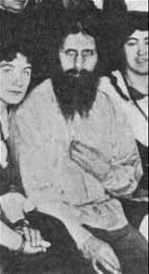
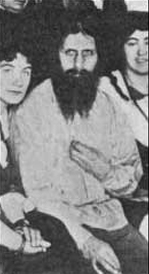
Litvinenko’s death was certainly bizarre, and as such, also quintessentially Russian. Consider: Leo Tolstoy died at a remote rail junction, having renounced his literature and wealth, and adopting the life of a wandering ascetic. Mystery continues to cloud Stalin’s death—stroke, or murder? Leon Trotsky was pickaxed—not icepicked—rather an exotic departure. And speaking of death exotica, Grigory Rapsutin (left) was first poisoned, then shot multiple times, then dumped into the frozen Neva River through a hole in the ice, where he later drowned, or died of exposure after climbing out downriver. Check the firsthand
account of one of the assassins, Stanislaus de Lazovert, as he describes the moments after Rasputin was initially shot: “The others came bounding over to him and stood over his prostrate, writhing body. It was suggested that two more shots be fired to make certain of his death, but one of those present said, ‘No, no; it is his last agony now.’ We left the room to let him die alone, and to plan for his removal and obliteration. Suddenly we heard a strange and unearthly sound behind the huge door that led into the library. The door was slowly pushed open, and there was Rasputin on his hands and knees, the bloody froth gushing from his mouth, his terrible eyes bulging from their sockets. With an amazing strength he sprang toward the door that led into the gardens, wrenched it open and (ran) out.”
Some would say this is the sort of thing travelers don’t really want to read about their destinations, but I disagree. The trend in tourism is toward authenticity and grit. Many people prefer to climb a volcano or kayak the Amazon than be directed to and fro by nametagged tour guides: “Don’t wander back there, sir—that’s off-limits.” A little danger is attractive—like a lover with a dark side. Tales of murder and backstabbing add intrigue to St. Petersburg, a city already far too beautiful to benefit much from the
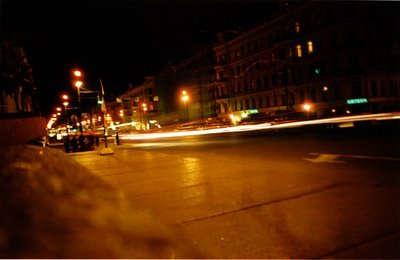
descriptive powers of bedazzled travel editors. But just for the heck of it, I’ll try my hand at travelogue right now: St. Petersburg is a metropolis of revolutionary monuments, hulking stone museums, and Venetian-style canals. The colors will surprise—the wedding cake palaces and ice cream scoop cathedrals form a Christmas cityscape beneath turbulent clouds that fume and roil in a white sky still sunlit come the stroke of midnight.
Yeah, that was fun, but I like the grit better.
Labels: russia, st. petersburg, travel
Flags of Our Soccer Hooligans, Part 2

I said I’d discuss Iceland again, and now seems as good a time as any, but I want to start with a clarification of my previous Iceland post.
First, I wrote that Bjork was in a hot dog line and I feel I need to explain that. As any travel book will tell you, hot dogs are the staple snack food of Iceland, strange as that seems. The main reason is that most food is imported, thus expensive—exorbitantly so. Reykjavik prices are about the same as those in say, Beverly Hills. That means a draft beer runs the equivalent of eight dollars. A typical restaurant meal, with no drinks, runs forty. But hot dogs are cheap, which means there is always a crowd of Reykjavik hipsters orbiting the many hotdog stands located in the middle of town. Of course Bjork is rich enough that she doesn’t have to slum around wiener stands, but perhaps I should add that Reykjavik wieners are the best I’ve ever tasted, with available toppings ranging from potato salad (my favorite) to fried onions. The only hot dogs that rival them are Hebrew National kosher dogs, the brand sold at many American baseball parks.
Second, I wrote that Icelanders hate foreigners, but that was a generalization I didn’t feel like clarifying at the time. Now I will. It’s actually Icelandic men who hate foreigners, and the main reason is because foreigners tend to hook up with Icelandic women. It’s all about protection of natural resources, people, though unsurprisingly, the resources in question don’t necessarily want to be protected. Below are pictured three very typical Icelandic girls hanging with three Americans, and as you can see, they aren't under duress.


It’s no mystery why foreigners like Icelandic women—they’re beautiful and have perfect skin. Why Icelandic women tend to reciprocate the attraction is open to speculation. I think perhaps it’s because some of them believe Icelandic men don’t offer much in the way of long term prosperity, mired as they are in a fishing and farming culture. The thought goes: why hook up with a guy who works at a tuna cannery when it's possible to escape the island with a rich traveler? Personally, I don't know if this supposed outflux of women is an actual fact, but I do know that many Icelandic men believe it and are willing to go to lengths to stop it.
There’s some irony in all this, since the only reason there are any women in Iceland at all is because the Vikings who settled there put ashore in Ireland first and abducted all the women they could find. This was a brilliant move, in a slobbering pirate sort of way, but at some point the women were bound to run away. The fact that it’s happening centuries later just makes it fate, generationally delayed.
Icelandic women are particularly vulnerable to the wiles of celebrities. During the Flags of Our Fathers shoot my friends and I preferred low key bars, like the little pub
Sirkus, where we could enjoy our eight dollar Heinekens in peace. But inevitably in such a small town, the cast members would eventually make an entrance, whereupon starstruck locals would dig out their phones and relay the news, causing the place to fill up in the next ten minutes with dewy-eyed blonde chicks.
I’ve spent a lot of time in Hollywood, off and on, and the thing you notice quite a bit is that celebrities are only as careful about committing a newsworthy fuck-up as they have to be. Since it was clear there were no paparazzi in Reykjavik, the (perhaps married) actors got pretty friendly with the local beauties. In fact I saw one girl high-fiving her friends on the way out the door in celebration of bagging a not-to-be-named trophy hunk. You’re thinking I could have read the scene wrong. But no, my girlfriend was in the women’s restroom with this group earlier and gave corroborating testimony that the girls were not high-fiving because of soccer results.
An L.A. girl would be way too cool to publicly celebrate being on the receiving end of a Hollywood infidelity, but Icelandic women don’t have that same kind of jaded reserve. Their excitement was actually sort of contagious, if a little uninventive. I was hoping they’d step it up a notch, give each other the NCAA flying chest, or maybe duckwalk out the bar like Shaq when he makes a tip-slam. Alas, Icelandic girls have a lot to learn about celebrating.
For the Icelandic men, of course, this was all a nightmare.
It was shortly after the high-fiving that my friend Dan was told by a pair of brave local boys: “Go home American. We don’t want you here.” I think this amply illustrates the worldwide guy credo: When in doubt, take it out on some random bloke. Dan should have responded: “Maybe you don’t, but your girlfriend does.” But besides being a stone killer he has evolved beyond the need to make petty quips (unlike me). And so he let these poor guys live to perhaps find enlightenment of their own one day. Nice work, Dan.
Now let’s go kill someone and dump their body in the woods.
.
Labels: bjork, iceland, sirkus, travel
Flags of Our Soccer Hooligans, Part 1
As my imaginary legion of readers out there have no doubt noticed by now, BlackNotBlack is about black-related subjects—social, political, pop-cultural, international—discussed by a person who escaped the United States, and the ghetto of the mind. It’s about participating in the world community and viewing events through the lens of that experience. No matter how well you think you know yourself, it is only from the outside that you see who you truly are. In a sense, it’s about getting outside your own skin. There are places in the world where your role in the social hierarchy is reversed, where you’re near the top, cops don’t pay you a bit of attention, and store owners’ eyes actually light up when you walk through the door.
Is this a revelation? No—black soldiers in WWI and WWII figured it out when they were shipped to Europe. Hundreds of black jazzmen felt it in Paris during the 50s and 60s. My favorite jazzman—Miles Davis—preferred Finland above all other countries. He said Helsinki was the only city in the world where he truly felt like a human being. The instant I read that I was ready to book a flight (and I did go to Finland a few years back, but that’s a story for a later post).
One place where you can get a 20/20 view of yourself from the outside is Iceland. I spent some time there visiting a stuntman friend during last year’s
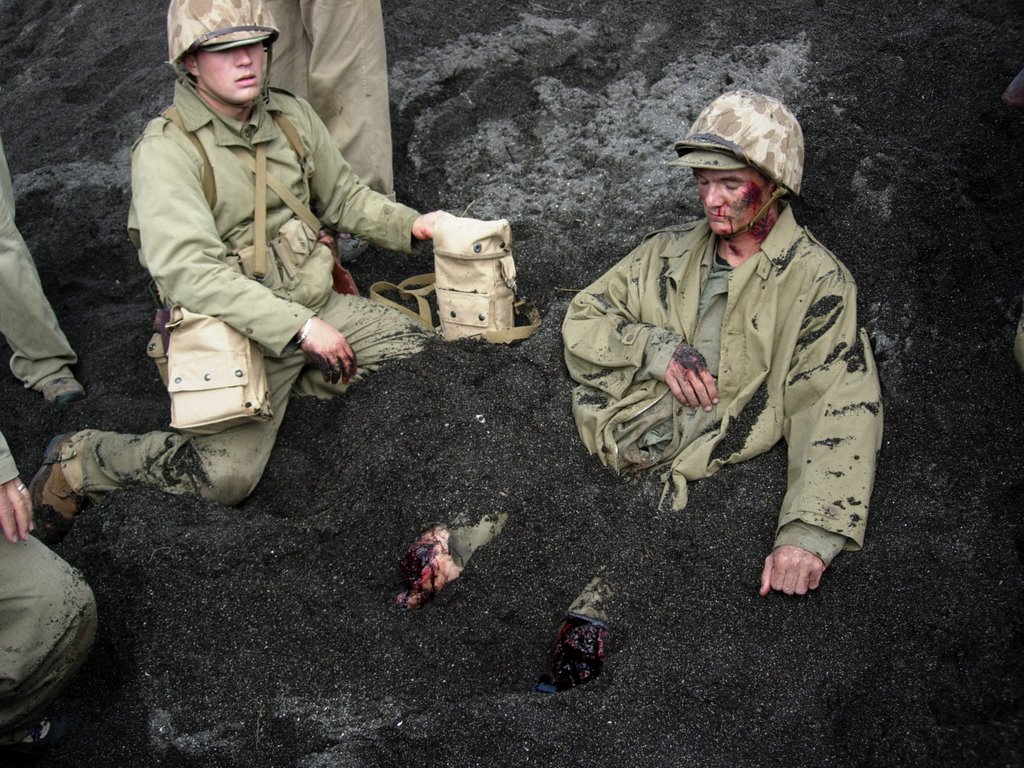
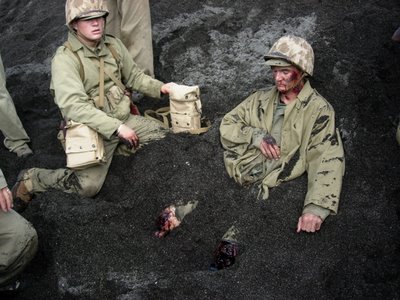
Flags of Our Fathers production. The movie is about war in the Pacific, but the only place in the world that looks like the Iwo Jima of the 40s is the Iceland of today, so Clint and the rest packed up their gear and boarded a plane. My friend is pictured above (in a scene later cut from the film) and, as you can see, one of his stunts was to play a guy who stepped in the wrong place at the wrong time.
To say blacks don’t often go to Iceland is an understatement. If it’s any measure of how much I stood out there, consider this: I ran into Bjork in a hotdog line and she stared at me more than I stared at her. Bjork, we can assume, has met hundreds of blacks—just not in Iceland. She was dressed in a long faux fur coat and bright red stiletto boots. It was strange seeing her, because I'd had contact with her camp before. When I was editor of a magazine some years back we asked her publicity firm for some potential cover shots to accompany a feature we were publishing. We wanted unique images, not the usual handouts, and so after some back and forth, they sent us several featuring her in a not-quite sheer shirt. Using the magic of Photoshop, we were able to tweak the contrast and levels enough to bring out her nipples fully, enjoyed a good laugh over the possibility of actually publishing the shot, then opted for a more conventional cover which showed only her lovely face. This whole episode went through my mind as I was looking at her. It's always the most juvenile pranks that give us the greatest pleasure, isn't it?
Icelanders like to fight. Some of them might disagree with that statement, but they’d do it by breaking your elbows. They especially like to break the elbows of foreigners, and it warms a special chamber of their hearts when the victim is American. In fact, “Go home Yankee” is the Icelandic national anthem. This sentiment is a result, I’m guessing, of the immensely unpopular American military presence there (bet you didn’t know your tax dollars are funding troops in Iceland, did you?).
American blacks travel so rarely to places like Iceland that a local’s first guess about where you’re from will invariably be England. Second most popular answer: France. Third (for me): Jamaica. So if you’re black you’re probably not American, in the Icelandic estimation. You’re just a foreigner. They still want to beat you down, but only in the getting-to-know-you way that you all laugh off later while sharing a round of Guinness.
In a little hamlet on the east coast of Iceland called Hofn some friends and I decided to go out for a drink one Wednesday night. After a stop at the harbor to watch the northern lights, we located a bar. Icelanders rarely drink during the week, but we were surprised to find the place empty. More than that, it had been closed minutes before. The owner told us he had opened only because the local football team had called and begged him for a place to party that night.
The look I exchanged with my friends at that point could best be translated as: “Oh great.”
I don’t mind being kicked out of joints. Hell, I’ve been tossed from bars on three continents. But I don’t kick myself out just because trouble is on the way. So rather than find another bar we hung around. When the footballers rumbled in the door (only six, rather than the expected eleven, plus subs) they were, let’s say, astounded by my presence.
Most Icelanders speak some English, and so the usual queries ensued: Who are you? What are you doing here? Why don’t you get your black ass out of our bar but leave the woman behind (just kidding, they were only thinking that, maybe). I escaped this situation by answering each question in Spanish. These guys’ brains were like fish on ice in a dockside market. I completely baffled them. Classically educated guys, they were probably remembering that the
Queensbury Rules on combat state that you can’t kick someone’s ass if they are unable to comprehend your intentions. So while they grappled with the puzzle of how to translate "going to beat you like a mongrel dog" into something a Spanish-speaker could understand, we slipped out the door.
I don’t normally back down at such moments, but these were football players, and there were six of them to three of us (not counting my girlfriend). They were short, like mascots rather than athletes, but you saw how Zidane up and Zidaned that Materazzi bloke in the World Cup? These guys, if they had decided to headbutt me, might have hit me in the groin. Anyway, you don’t fight outnumbered six to three, even when your friend is a stuntman and a stone killer (sorry to blow your cover, Dan). We might have won, but on the other hand, one good shot on Ari (who is definitely a lover, not a fighter) and it would have instantly been six on two. Even having a killer at your side won't help you then. Real life ain't
Enter the Dragon. By now most of my non-readers, I imagine, are thinking Iceland is not a country to visit, but you learn more challenging yourself in a place like that than regurgitating cherry Jell-o shots on a beach in Cancun. Call me crazy, but I loved it there.

There were also some non-violent nights in Iceland (typical sunset pictured above), but those are (you guessed it) for a later post.
Labels: bjork, iceland, travel
Clan of the Drum
I lived in Guatemala for a couple of years, and while I was down there—in a city called Antigua—blackouts became part and parcel of my life. I never had any previous experience with them. I know there was a massive 1965 blackout on the east coast of the United States that plunged 80,000 square

miles into darkness. And supposedly, nine months later, there was a spike in childbirths in east coast hospitals. Apparently there was really nothing else to do when confronted by Armageddon. No lights meant Russian missiles, the end of the world, a last chance to party in the face of the apocalypse. Inhibitions vanished, skirts dropped, and nature took its course.
In Antigua, sometimes the blackouts didn’t happen for a few months. Other times the lights failed twice in a week. These spells typically lasted a few seconds, but occasionally the world went black and stayed that way. We crossed the river Lethe into a new reality; a million new stars appeared in the night sky. The primal self, safely housed in the convolutions of the brain’s limbic system, suddenly broke loose to howl at the moon. Man gave way to beast.
Most people who lived in Antigua already felt as if they’d stepped back in time. When the lights went out we simply got a chance to step a bit further back and become hunter-gatherers sharing folk tales around the ancient fire. Huddled around candles, people probed a little deeper, responded a bit more candidly, and revealed more. And interestingly, the volume of conversation dropped dramatically.
If I wished to consult a psychologist, he or she would probably suggest that these things happened because of subconscious fear. Darkness is cold, darkness is loneliness, darkness is death and dreamless sleep and other untold evilness. Surrounded by it we huddled for protection like a tribe. I don’t have the spare cash to actually consult an expert, so I’m going to go out on a limb and say this theory is correct—deep down we were driven to seek each others’ companionship for safety when darkness closed in.
The most interesting blackout I experienced occurred in the town of Monterrico. Three hours south of Antigua by car, Monterrico is a tattered, tropical community of high surf, black sand, and mañana beach culture that moves as slowly as coastal erosion. Usually a night in Monterrico means a meal at dusk in one of the shacks that serve as restaurants, and then late drinks and music in a shabby beachfront bar. But this time the electricity died and the rules changed just a bit.
Our group of twelve noticed the blackout had occurred as we walked along the beach after sunset to the restaurant Caracol. All along the shore candles wavered like tiny signal fires from the windows of houses and hotels. Caracol looked shut, but when someone in our little clan called hello the owner appeared with a lantern and began pushing tables together and lighting tapers. You don’t expect a party of twelve during a blackout, but she gave us four-star service by candlelight and capped off the meal by comping us a dozen free shots. Generosity, too, emerges in the dark.
After dinner we walked to a wood and thatch palapa-style bar called El Animal Desconocido. Like all the other places along the beach, El Animal had been reduced to stoneage technology. Henri, the owner, stood shirtless behind the bar, sweating heavily in the heat generated by the many candles he had lit. A steady buzz of conversation issued from the customers, perhaps twenty people divided into a half dozen separate cliques. Someone had brought a drum and he began playing it. Nothing strenuous, just a little background noise. But it was a welcome sound. You don’t realize how dependent the atmosphere of a bar is on music until you walk into one that lacks it. And as often as you hear drums in Guatemala, you can never appreciate them until they’re the only form of music available. It is not overextending the tribal analogy to suggest that the sound of the drum began to unify the occupants of the room.
Before long someone else took up the beat. He played loud and fast, sending riffs exploding up to the rafters, intensifying the energy level in the bar until people were driven to dance. This second drummer was really good. He really lit a fuse in the room. Actually, the second drummer was me, but I’m simply suggesting that people will usually ignore even a well-played drum except under the circumstances forced upon them by the blackout. With new rules in effect, the drum helped transform rabble into a community.
It went on like that for a couple of hours—my drumming, everyone else dancing, drinking, and sweating. All of our howling primal selves were loose. As in the great blackout of 1965 inhibitions vanished, skirts dropped, nature took its course. It was phenomenally exotic, entirely unforgettable, and though I was the only black person in the town, I was the same as everyone else inside the fragile bubble of that moment. Why did it happen? Perhaps it was the drumming, or the liquor, or the spell of Monterrico. But I think it was the blackout, the rules changing, and inhibitions evaporating as everyone formed a tribe to resist that oldest of enemies—darkness.

Many of the people at El Animal that night had never spoken to a black person before. They marveled that more didn't visit Guatemala. Because of my little act as an ambassador with a drum, they were convinced that their country needed more blacks. Shit, we were fun—we knew how to party. The few Guatemalan blacks—called Garifuna—lived in isolation on the Caribbean coast and were rarely seen. Now these rank and file Guatemalans were wondering about the Garifuna. They were primed to abandon everything they'd absorbed about blacks from years of watching old American sitcoms. They asked if any of what they'd seen was correct. I asked them: "Whenever Guatemala makes the international news, like CNN, do they get it right?" Everyone laughed at that. Of course they didn't get it right. They got parts right, but never the important parts. I told them it was the same for me. American television gets parts right, but not the important parts. My Guatemalan friends got it. The analogy stuck.
All this potential for change came from a blackout and a sweltering bar that had no music. You have to keep alert for these moments. It might be a blackout, or it might be something else, but when that doorway opens, stepping through it can change people's minds. Easiest thing in the world to do, and a hell of a lot of fun.
.
Labels: drums, guatemala, monterrico, travel
 My former home country of Guatemala has been popping up in the news quite a bit lately, for all the wrong reasons. First there was the giant sinkhole that swallowed half a dozen houses, quickly followed by last week’s 6.8 magnitude temblor. But those were just warm-up acts for the astonishing headliner. In the frontier town of Camotan this week, a mob numbering 2,000 people attacked three women on suspicion they had killed a young girl and stolen her organs to sell them. The missing girl—nine-year-old Mishel Diaz—disappeared from her home and was discovered a day later, mutilated and abandoned near a little-traveled dirt track. Reports said her arm was cut off, her eyes gouged out, and the skin on her chest removed in what looked like an attempt to steal her heart and kidneys.
 As bizarre as this story probably sounds to people who have never visited Guatemala, the fear among residents of their children being stolen and harvested for organs runs deep, particularly among rural Mayans. The fear has taken on the character of folklore, with most swearing it has happened to the daughter or son of a friend. I heard the stories firsthand, but in reality there is no substantiated proof of organ harvesting there.